
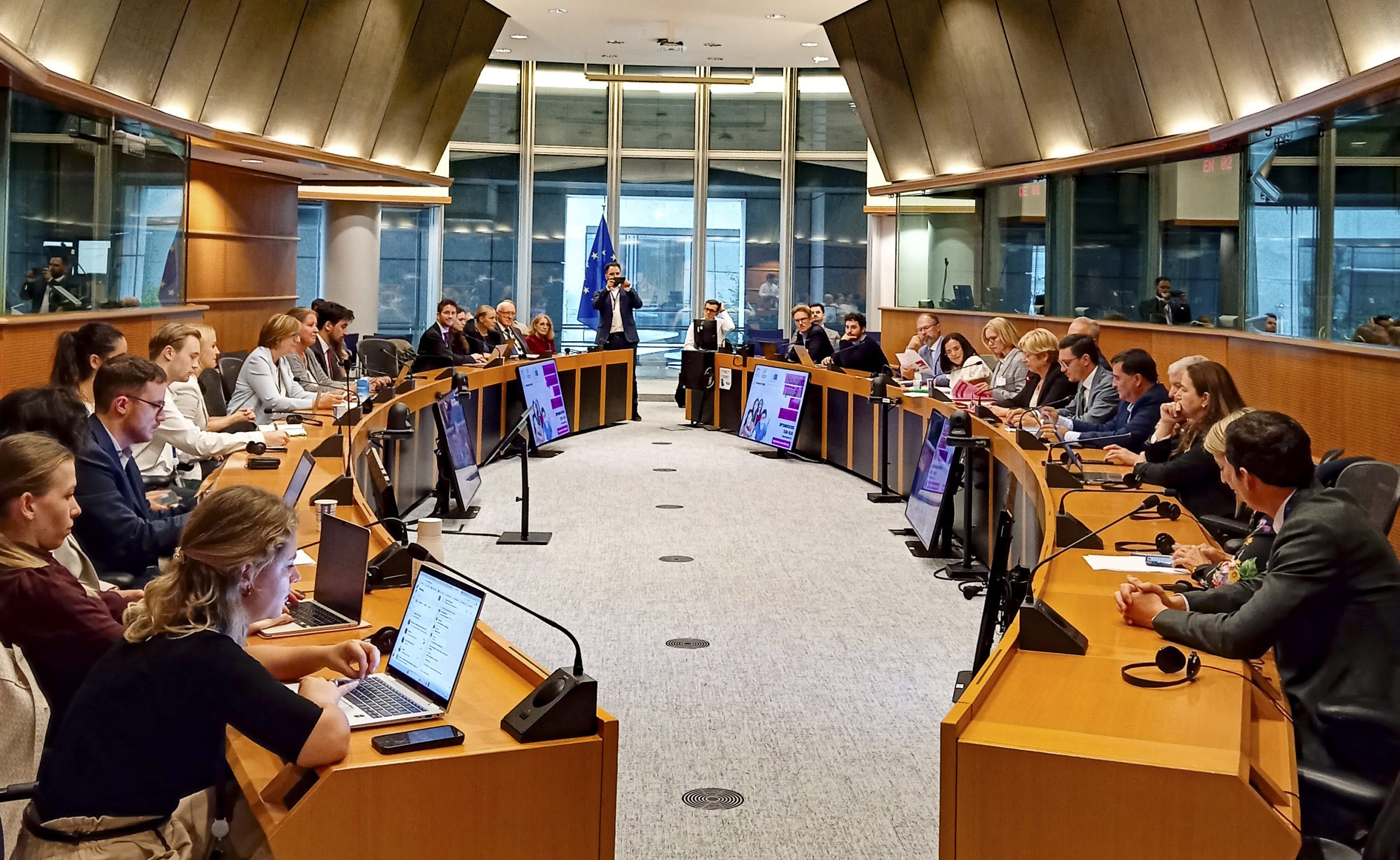
The factors that European legislation on “Affordable Housing” should take into account were the focus of discussion at the panel on housing and family, held on 9 September at the European Parliament, organized by the European Confederation of Large Families (ELFAC), the European Parliament’s Demography Intergroup, the European network familycities.eu, and the Coalition for the Future of Cities.
In 2025, 23.4% of households in the European Union (EU) included children. Among these households, 37.6% had two children, while 12.2% had three or more. Given that families comprise a substantial portion of EU households—and that over 25% of European children live in large families—it is crucial to evaluate how housing policies directly impact them.
Raul Sanchez, secretary general of ELFAC, moderated the event. In the opening he remarked the importance of facing the housing challenge with two main objectives: “We cannot overlook the family perspective when tackling the housing problem in Europe, which is closely linked to the serious birth rate crisis we are facing. The market must offer a variety of accommodation options, both for families living in one place and for those seeking temporary accommodation: everyone must be able to find a place to live.”
Regina Maroncelli, vice president of ELFAC, discussed the greatest housing challenges faced by families with more children: “In many European countries there are housing policies for families at a local level, while too few national policies take into account the number of the children as a criterion to deliver support”. According to Maroncelli, large families in Europe face a compounding crisis of housing insecurity, financial exclusion, and bureaucratic neglect.
Maroncelli said that “the EU Commission’s Affordable Housing Plan provides forms of support for vulnerable groups, but these do not include large families, even though they face the highest risk of poverty or social exclusion (29.6 per cent). Including families with children among the supported categories- for renting, buying, renovating or making houses more efficient- and making the Plan more “local” would serve as an investment for the future of Europe”.
Just the same day, the European Commission has approved the “Affordable Housing Act,” the main points of which were explained at today’s event by Grzegorz Gajewski, a member of the Housing Task Force that spearheaded this legislation within the Commission: “While housing policy remains a national competence the European Union plays a crucial role in facilitating the exchange of best practices and supporting member states as they address their expanding housing needs. However, addressing the housing crisis requires looking beyond mere affordability to embrace long-term sustainability; integrating energy efficiency and conservation into housing solutions is essential to reducing household costs and building resilient communities for the future.”

Gajewski concluded by saying that “we are facing a fundamental challenge in Europe, one that requires everyone’s contribution.” For this reason, he expressed his appreciation for today’s event as a way to hear the needs of large families and incorporate them into the Plan, and he asked ELFAC for continued collaboration so that the family perspective is not lost in the solutions that are proposed.
Members of the European Parliament have also established an intergroup dedicated to demography. Five of its members—Paolo Inselvini (ECR), Vasile Dîncu (S&D) and Romana Tomc (PPE) as co-chairs, and Margarita de la Pisa (PfE) and Fernand Katheiser (NI) as members—attended the event, with each emphasizing during their speeches the critical need to address housing in light of the ongoing demographic crisis.
Elina Treija, from Riga municipality (Latvia), Head of the Committee of Housing and Environment, emphasized two distinct problems: Insufficient housing space and inadequate living area. Old housing that is expensive to operate, energy-inefficient and outdated.
Treija provided two solutions to the first problem: “A municipal rental housing stock offering below-market rents for families with children; with a housing guarantee for families starting from the first child. And State grants and guarantees for housing mortgages.”
For the second problem her proposals were “Passive support – municipal/state benefits to partially cover housing maintenance and utility costs. And Proactive support – co-financing for insulation, renovation and more energy-efficient heating solutions (strongly hope for meaningful and non-bureaucratic access to European Social Climate Fund resources in the next programming period)”.
Regarding proposals to substantially reduce—or even ban—short-term rentals in the most popular tourist destinations, Silvia Pastor, Institutional Relations of tourism apartments association APARTUR, from Barcelona (Spain), said that “family-friendly cities must acknowledge that short-term rental properties offer a solution tailored to families who need greater capacity, more space and flexibility — and who also face a necessarily higher travel cost due to the number of members in their group. Significantly reducing this supply can limit their accommodation options, increase the cost of their stays and, in the worst case, make it harder for them to travel at all”.
Pastor finished her intervention saying that “we should not have to choose between a city where families can live and a city that sustains the economic activities of its resident families — activities that are essential to its vitality. The challenge lies in finding that balance”.

Silvia Cipelli, coordinator of the European Network of Family-friendly Municipalities and ANFN, in her speech insisted on the importance of networking at European level, underlining how certain common issues are better addressed and faced, if done together.
Talking about the European Network of Family-friendly Municipalities, she stated: “ANFN and ELFAC are ready to play their part through the family-friendly companies and municipalities frameworks. Our ambition is not to create another label or another certification. It is to create a European community of businesses, municipalities and families that learn from one another and choose to invest in the future in practical ways. Because a good family policy must not be limited to supporting the family only after a child is born. It must create the conditions for every family to freely build its future and – if they wish – welcome children. At ANFN we have a slogan: ‘more children, more future’. And I believe that today here in Brussels we can have an even greater awareness: no nation has a future unless it chooses to care for the next generation”.
As part of the representatives of Civil Society Organizations, Sorcha Edwards (Secretary General of Housing Europe) stressed how difficult it is to act at European level, since every local context has its own peculiarities: “We don’t have one housing market in Europe, we have thousands of local, diverse, housing contexts and housing markets”.
She later remarked the importance of acting at the local level: “What we see is that many local organizations acting as house providers are embedded in the fabric of the economy. They are actually providing for the local needs. […] They are embedded in the community and therefore can forecast and adapt to the different needs”.
Federico Nahuel Lazzari (Build Europe) insisted instead on the cultural shift that, during the Covid-19 period, made Europeans reconsider the meaning of the word home: “[During Covid] house became something else. It became the place where you have to work, where your kids have to study and where they need their own space. […] Families were asking for green areas, larger spaces, one extra room”.
A solution could be, according to Lazzari, to boost less-populated areas: “Giving the right to choose where to live could help us spread the demand somewhere else (where land is more affordable), make people happier and change the current paradigm. We could start from the tertiary sector (currently accounting for 32% of European jobs) and reactivate local economies, create healthy competition between municipalities that could try to attract people by creating attractive infrastructures”.

The Senior Policy and Advocacy Officer of COFACE Attila Bohm emphasised how large families are one category recognisable as particularly vulnerable and specifically called for EU to address this vulnerability: “We call for families in vulnerable situations to be highlighted as target group in this Affordable Housing Act – since it has been published today – and also in housing policies in general”.
Tünde Fűrész, representative of Hungarian Family Network Foundation, presented Hungary’s successful family-friendly housing policies, such as reductions on utility prices by regulating tariffs of natural gas for large families and home renovation programs especially designed for families with children. “We believe that promoting and supporting housing programs and investments would have a positive impact not only on families, but on the economy at the same time” she firmly stated.
To conclude, the floor was given to Josianne Cutajar, Former MEP and Independent Chair of the Future of Cities Coalition. In her speech, she resumed some of the main themes discussed throughout the panel.
She concluded by saying: “A family-friendly city cannot be built by one stakeholder alone. It requires policymakers, industry, civil society, and cities to work together, making today’s event a valuable space to discuss housing and families, while recognising that a family-friendly city also depends on mobility, services, public spaces, resilience, and sustainability. This is why I accepted the role of independent Chair of the Future of Cities Coalition; its work connects housing, mobility, sustainability, resilience, and tourism through a holistic, evidence-based, cross-sectoral approach. I invite you all to join the Coalition to continue the discussion from multiple but interconnected angles!”