

A family-friendly Europe is a fairer, stronger, and more supportive Europe, capable of facing the challenges of the future with greater confidence and determination.
By Alfredo Caltabiano, president of Associazione Nazionale Famiglie Numerose (ANFN)
The family is the fundamental cell of society, playing a vital role in its development and well-being.
It is a pillar of the community, as it is the main social safety net, due to the irreplaceable roles it plays daily, totally free of charge and with enormous benefits for the entire community.
First of all, it performs a procreative function, which is increasingly important in an already elderly population that is destined to age further progressively.
It then has a fundamental welfare function, care, breeding, and social solidarity towards children, sick people, disabled people, and lonely people, which no public service can replace.
It carries out an equally important primary and basic educational function, capable of developing all the potential of the human being, in a climate of serenity, openness of life, trust, and security.
In a society characterized by the economic crisis and an ever-increasing lack of security, the family becomes an important bulwark thanks to its economic function and its function of protection from external dangers.
The family, with its socializing function, is the first training ground for socializing children, who learn to live with the other members of the family unit; finally, it carries out a function of cultural transmission and support in adversity.
No public or private entity can replace the Family in these functions with the same quality; but even if they did, they would have infinitely higher costs. This is why investing in the family is the most socially and economically advantageous solution for the community. Large families are the ones that perform most of these functions.
Through its different phases, the family contributes to economic growth, social cohesion, and the transmission of values.
This is why it becomes important to support the formation of the family in every single step:
- Its birth is through the creation of a positive climate for young people that allows them to think with confidence about a life project. Accessible housing and stable and adequately paid work contribute to promoting this climate;
- With the birth of the first child, policies of harmonization between work and family become fundamental, together with an adequate offer of nursery schools that are accessible in terms of proximity, availability, opening times, and finally economically;
- With the second and subsequent children, the purchasing power of the family inevitably reduces, which must therefore rely on economic, fiscal, and tariff support;
- Then when you become a large family, with the third and especially the fourth child, additional elements come into play to manage, such as a car and a suitable house.
We can say that large families are the last level of a video game: you must first have passed all the previous levels… But, unlike video games, the problems of the previous levels always remain valid for large families!!!
Children, in particular, are a fundamental resource for economic development.
More children mean more growth, because they increase domestic demand for goods and services, stimulate innovation, and create new jobs.
In an ANFN study from eight years ago (2016), we calculated the benefit that Italy would have had by investing significantly in the birth rate and young people: this benefit can lead to an increase in GDP equal to +1.65% per year and at +8.25% over the 5 years, with effects on employment equal to 200,000 new jobs per year, 1,000,000 in 5 years.
Europe, however, is following the opposite path to the one we hoped for. The investment in the birth rate is not perceived, even the word birth rate, like the word family, seems banned in Brussels. And this, despite Europe facing an unprecedented demographic decline
The consequences of this decline are worrying: a progressive aging of the population, a shrinking workforce, an unsustainable pension and healthcare system, and a loss of competitiveness at a global level.
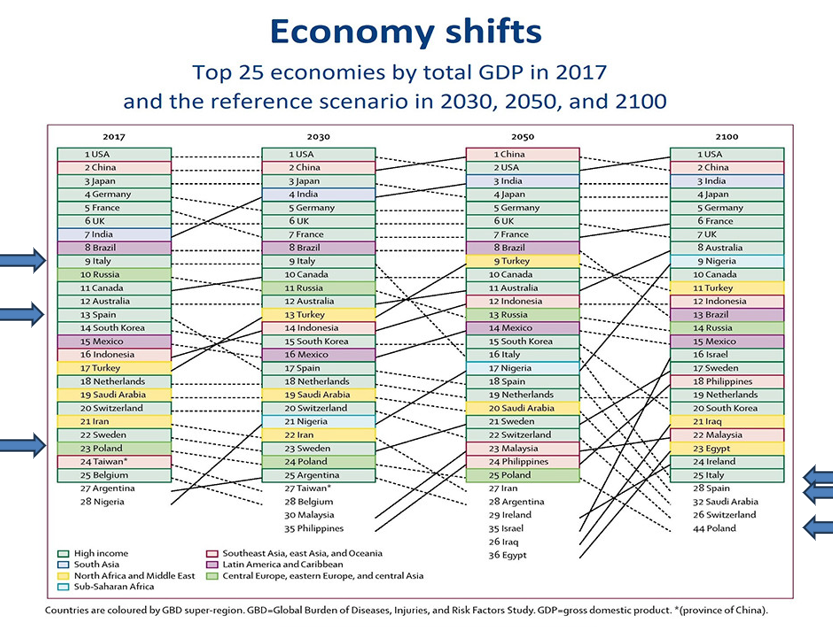
In this regard, we highlight how several European countries, following demographic dynamics, will lose numerous positions in the world GDP ranking at the end of the century: Italy from 9th to 25th place, Spain from 13th to 28th place, and Poland from 23rd to 44th place. And they will be preceded by nations such as Nigeria, Philippines, Iraq, Malaysia, Egypt…
This is how, in this scenario, large families play a crucial role. Families with three or more children not only help offset the number of women who have only one child or none at all but represent a positive social model, based on solidarity, sharing, and openness to the future.
It’s not about forcing anyone to have children, but about creating the conditions so that every couple can realize their family project, with the desired number of children.
A change of mentality is necessary: children must not be perceived as a burden or a luxury, but as an investment for the future, a common good to be protected and enhanced.
A ‘Marshall Plan’ in Europe
It is, therefore, necessary to promote a ‘Marshall Plan’ in Europe that intervenes 360′ on all aspects that affect the birth rate: work, housing, conciliation policies, taxes, tariffs, economic support, healthcare, the latter due to the growing infertility present among young people. And then we also need to intervene on a cultural level. All this, allocating the necessary resources to deal with this emergency, in the same way as environmental issues are being addressed in Europe.
And, speaking of the environment, let’s remember how large families are by far the most environmentally sustainable. Through the sharing of resources, reuse, economies of scale, and shared mobility, per capita energy and water consumption is significantly lower than singles or couples without children.
Here then is how large families can be the unexpected weapon for the relaunch of Europe. Investing in them means investing in the future, in economic growth, in social cohesion, and hope. A family-friendly Europe is a fairer, stronger, and more supportive Europe, capable of facing the challenges of the future with greater confidence and determination.