

Current research shows that material status can have an impact on the decision on whether to have children. But without a doubt, it is not the only factor. Value motives are often behind such decisions.
From Davor Dijanović of hkv.hr
Can you briefly introduce your family?
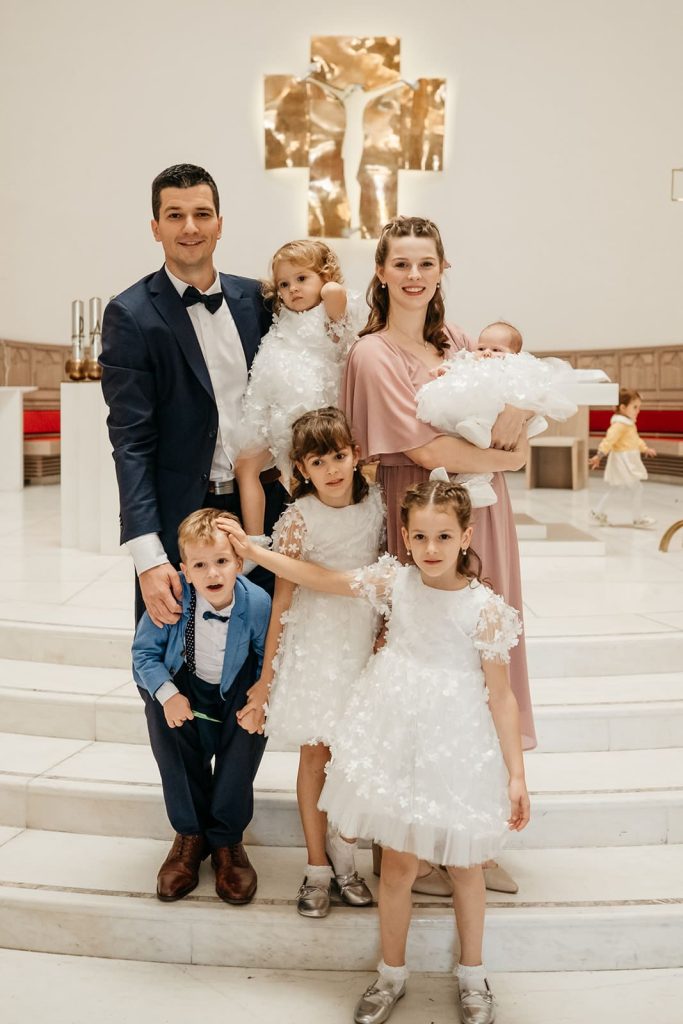
We are Mateja (30) and Kristijan (32) Glavaš from Zagreb. We have been married since 2015, and in these almost 10 years we have been blessed with five children. In addition to the newborn, we have two children of kindergarten age and two schoolgirls. We are both graduates of the University of Zagreb, Mateja with a degree in political science and Kristijan with a degree in economics, and Mateja also completed a one-year postgraduate study in Marriage and Family Pedagogy at the UIC in Barcelona. We have been in business consulting through companies in Croatia since 2020 and in Germany since 2021. Although we both went to elementary school outside of Zagreb (Sisak and Ivanić-Grad), we have been extremely attached to Zagreb since our high school days, either through daily travel or living in a student/student dormitory, and soon after the wedding we settled permanently in Zagreb.
At the beginning of your marriage, did you think about wanting to have more children? Today, namely, many people are calculating and usually want to have one or two children…
The desire, or rather openness to life, i.e. the opportunity to have more children, was natural to us from the very beginning of our relationship. Since we knew that we would get married relatively young (23 and almost 21 years old), and that we would be open to life in marriage, we hoped to have a large family. Aware that we do not have the last word on how many children and when exactly we will have them, and not wanting to limit ourselves from the beginning on how big a family we will have, we always joked that there would be 12. That was some figurative number after which people would most often stopped asking how many children will be planned.

To what extent did economic and financial motives play a role when entering into marriage and making a decision about children?
From the very beginning, we knew that finances would always be a challenge, but we also did not allow ourselves to be intimidated by this challenge. Faith and trust in God’s providence play an important role in forming our view of the world and ourselves, so we embarked on this adventure of marriage and life in an unusual way, but far from an irresponsible way. Thanks to St. Benedikta, we have known about “Ora et Labora” since more than the 15th century, and in this way we also live our finances – we ask God to provide us with what we need (always in addition), and at the same time we know that we must roll up our sleeves and work hard and smart , not only at work, but also on ourselves.
We got into a relationship at the beginning of the summer of 2012 thanks to our summer jobs, which forced us to be creative in finding dates to go to St. mass on weekdays. The pace of continuous work alongside studies, as well as full-time seasonal work kept us going throughout the dating and engagement period and the first year of marriage. And even after that, through formal and informal forms of education, we continuously invest in ourselves in order to achieve the best possible financial results in the labor market and intellectual services.
However, value motives also play a big role, that is, Christian openness towards life?
Absolutely. Without value motives, that is, the role of faith in individual life, and then also in married and family life, we would hardly have found ourselves in the current situation we are living by chance. We sincerely profess the Catholic faith and consequently strive to live in accordance with the moral teachings of the Catholic Church, which also applies to the issue of sexuality. Thanks to the encyclical Humane Vitae of Pope Paul VI. and “Theology of the Body” St. of Pope John Paul II, which was popularized in our high school and student days by the couple Evert from the USA and the student chaplain in Zagreb at the time, Don Damir Stojić, extremely early on we each individually discovered the beauty of chastity and purity, which also represent the essential evangelical bliss of speech on the mountain “blessed are the pure in heart, they will see God” and since high school days we try to accept him and live fully – individually and through relationship and betrothal, and today marriage.
What do you think is the perception of numerous families in Croatia today? Should that relationship be changed?
What is a large family? Statistically, according to the 2021 census, almost 88% of families had 1-2 children, almost 10% of families had 3 children, and 2.6% of families had 4 or more children. Shares and proportions have changed slightly, although there are 100,000 fewer families in Croatia than in 2011.
If we talk about the perception of 4+ families as a large family, we can safely say that it is something exotic and unusual (which the statistics show). It is difficult or ungrateful to enter into more specific analyzes of society’s perception, but they seem dominantly negative, even though it is in the interest of society as a whole, and of the state, either as mothers or as stepmothers, to have as many families as possible with as many children as possible, so the attitude towards such families should be more affirmative.
Family, however, is actually the foundation of everything?
The family is still the fundamental unit of society, from which the life of new generations and future generations emerges. It is still a basic school and preparation for life, which is why it is extremely important to get involved in thinking about and organizing family activities. We were lucky that in the first year of marriage we got to know family enrichment courses conducted by IFFD Croatia (International Federation for Family Development). Where we learned through various modules and created a network of friends with other families who do not make our large family an isolated case. We often recount the incident in which our 5-year-old daughter, to the comment that there are a lot of us because we are waiting for the 5th child, replies, what do you mean a lot? so there are 6 of these, 7 of these, 9 of these… there are only 5 of us!
What do you think the state could do to make it easier for parents who have more children? Are tax reliefs a good solution?
There are numerous ways in which states make it easier for parents to fulfill their socially beneficial obligation to receive and raise children, and tax relief for mothers and families in general is certainly one of them. The Association of Families 3plus came out with a specific list of 12 measures that would help in this direction.
First of all, it is necessary to raise awareness of how essential and important children are not only for society, but also for the state as such, and take as many steps as possible in the direction of reducing the negative financial effects. With political will, it is possible to really do a lot.
Do you have more materially today or did you have more at the beginning of your marriage?
In every sense, we have more today compared to the beginning of marriage, even materially. We continuously work on financial literacy and apply the learned principles in everyday life. We monitor the approximate value of all assets at our disposal (money+securities+movables+real estate) and strive through regular budgeting to be faithful stewards of the assets entrusted to us.
From the first days of our relationship, we started applying the biblical principle of giving tithes to God (through the Church or directly to the needy) and we believe that in this way we leave enough room for smaller and bigger miracles that then happen. Considering the modest beginning of the relationship (about €1,000 in savings), it is not difficult to have more. We think that’s a good thing, because often when we ask ourselves “what if”, we return to the idea that we’ll be like at the beginning and go from the beginning again, which is not so terrible.
How do you balance work and family life, which is undoubtedly challenging in a large family?
Challenging is the key word. We always miss an hour in the day, and a day in the week, but that’s how it is for most people and it’s a default variable in the formula of life, so there’s no point in asking for extra time. We certainly continue to hone time management as a skill, but in principle, being aware of life’s priorities, we arrange schedules as well. It often happens that we are late somewhere or that we do not manage to squeeze some things that we would like into the schedule. But we also know that we have to find time for marriage, time for children, for friends and for ourselves. We jump in and support each other, and through trials and failures we get better and better at organizing days and weeks. Most often sleep suffers, but we will rest when the children grow up or when we die.
What is your message to young families?
“Don’t be afraid! You are the future of the world.” Those are the words of St. John Paul II. he always instructed the young people he met, and they are deeply engraved in our hearts. We would like to encourage all young people who are afraid of the future and who are afraid of challenges and risks to put that fear aside and start living, to surround themselves with friends who will accompany them on this path of hope. Wherever we turn, we can find a reason not to do something, not to engage in some venture or not to take some step that our heart urges us to take. Life is too short and too precious to spend time in fear. Does this mean that negative things do not happen or that they cannot happen to us? Of course not, but if we are looking for a deeper meaning in life, we can find it not only in joy, but also in difficulties and suffering.