
In 2025, out of 203.1 million households in the EU, only 47.4 million, or 23.4%, included children.
Most of these were couples with children (14.7%), other types of households with children (5.6%) and single adults with children (3.0%).
The remaining 76.6% of households without children comprised of single adults (37.5% of all households), couples (24.1%) and other households (15.1%).
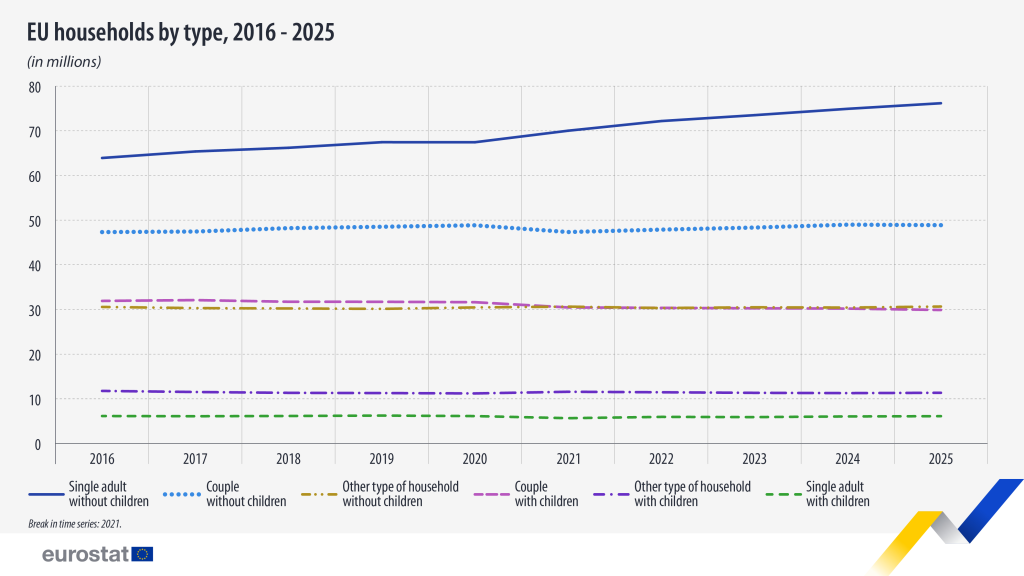
Between 2016 and 2025, the number of single adult households without children rose by 19.2% (from 63.9 million to 76.1 million) and the number of households composed of couples without children increased by 3.3% (47.3 million to 48.9 million). In contrast, the number of households with couples and children dropped by 6.3% (31.9 million to 29.9 million), and other types of households with children decreased by 3.5% (11.8 million to 11.4 million).
Households with children: from 18% in Finland to 35% in Slovakia
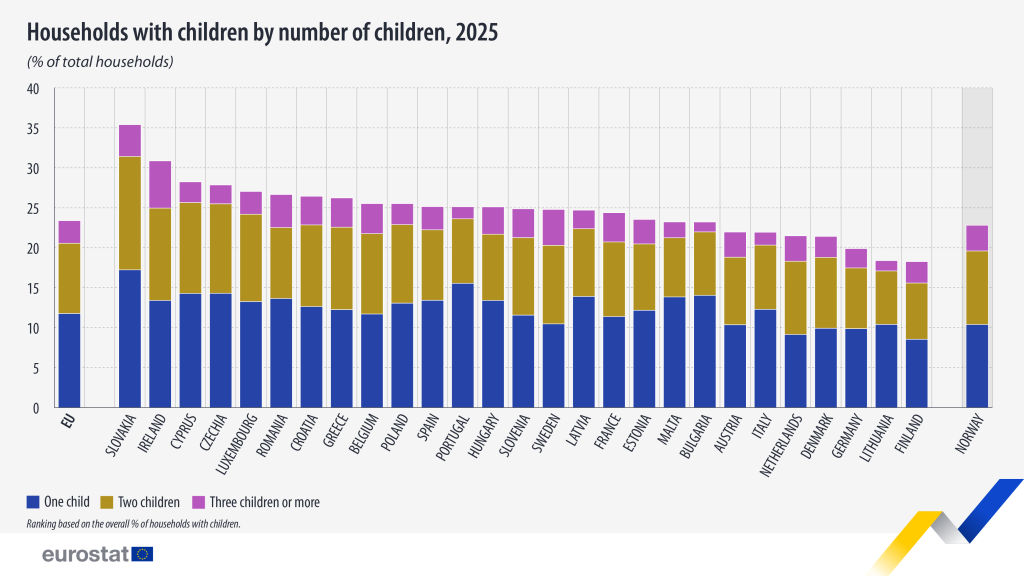
The highest share of households with children was recorded in Slovakia (35.4%), Ireland (30.8%) and Cyprus (28.2%). On the other end were Finland (18.2%), Lithuania (18.4%) and Germany (19.9%).
Half of all households with children had 1 child
In 2025, 50.2% of EU households with children had 1 child, 37.6% had 2 children, and 12.2% had 3 children or more. Households with 1 child were particularly common in Portugal (61.8% of all households with children), Bulgaria (60.4%) and Malta (59.5%).
In 14 of the 27 EU countries, most households with children had 2 or more children. This share was the highest in Sweden, with 57.8% of such households, the Netherlands (57.6%) and Ireland (56.7%).