
By Franco Grotto, Stefano Lipparini, and Alfredo Caltabiano on ANFN
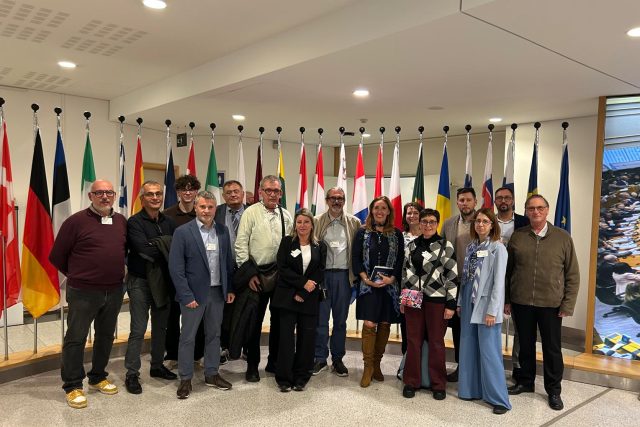
Thanks to the renowned resourcefulness of our association’s dean, Franco Grotto, we took advantage of the opportunity for MEPs to invite citizens from their constituencies to Brussels to learn about the workings of the European Parliament.
For us, it was the Honorable Elena Donazzan, whom we had known and appreciated as the Veneto regional councilor, always attentive and responsive to our needs, who reserved a space for us, along with other citizens, including some local administrators from Trentino.
The expedition was attended by Franco, Dario, Maria, Alessandro, Andrea, Tatiana 1, Tatiana 2, Edoardo, Marco, Margherita, Paolo, Riccardo, Enio, the arbitrator Stefano Lipparini, the president Alfredo Caltabiano, and, representing our “large children,” Ester, Davide, and Rebecca.
The initiative—held on October 13 and 14 in Brussels—coincided with the public budget season, which saw ANFN participate, along with the National Family Forum, in the recent meeting at Palazzo Chigi, organized by Domenico Menorello of the Ditelo sui Tetti network, with authoritative government representatives, as reported on ANFN’s website.
Alongside official visits to Parliament and the places where European democracy lives (as well as, let’s face it, a few intense vacation and family breaks in a beautiful and inclusive city), we presented to the Hon. Donazzan the issues that are closest to our hearts right now, including: a law for large families, the national family card, the issue of mobility (car tax and 4% VAT on car purchases, the cost of public transport), work-life balance for businesses, access to mortgage credit for home purchases, and pensions for our mothers, especially those who have stopped working to dedicate themselves to their children. On every aspect, the Hon. Donazzan took notes, sketching out ideas and paths to achieve concrete results, also by engaging with Italian government officials he has known and frequented for some time, including Undersecretary to the Presidency of the Council of Ministers Alfredo Mantovano and Ministers Giorgetti, Roccella, and Locatelli. The commitment was to proceed in concrete steps on each point.
In this mission, we involved another member of the constituency (which includes Veneto, Trentino-Alto Adige, Emilia-Romagna, and Friuli Venezia Giulia), the Hon. Stefano Cavedagna of Bologna. He is a young politician (36 years old) who is sensitive to family issues, having gotten married before the summer and having told us he knows our association as a close friend of the children of Alberto and Teresa Cuppi, the first Bologna coordinators in the early days of our association. Since the European institution cannot influence the actions of individual member states, the Hon. Cavedagna, very pragmatically, asked us how he could help. He told us he was part of a cross-party and cross-state commission that addresses the serious problems, both Italian and European, of the decay of values tied to Christian roots, to individuals and families, to the declining birth rate, and to the aging population. In light of this, we presented our activism to Elfac, through Vice President Regina Maroncelli, and the proposals of both Hon. Cavedagna and Hon. Donazzan (also a member of the above-mentioned commission) to organize a hearing to present not so much the list of things that aren’t working (an endless list), but rather best practices within individual countries so they can be shared and replicated. We’ve established the necessary contacts, and the hearing will be convened in Brussels as soon as possible.
As if that weren’t enough, on our return flight we found ourselves alongside Mabel Bilato, Councilor for Social Policies of the Municipality of Albignasego (PD), who works as an assistant to Filippo Giacinti, Regional Budget Councilor for the Veneto region (former mayor of Albignasego). Giacinti was also on the plane with us returning from a mission to Brussels as guests of the Hon. Cavedagna.
In short, a mission full of opportunities to be seized and cultivated in the European, national, and local contexts.
We conclude by recalling two images of Brussels that are less publicized than the European Parliament, yet are well-known and familiar: French fries, or “frites,” invented in Brussels, famous and enjoyed around the world as well as a staple of our tables; and the statue of a naked child doing his business, a street-corner attraction sought by tourists amidst institutional buildings and historic monuments, admired, photographed, and reproduced as lucky charms. Perhaps, by looking at a naked child in a physiological gesture and thinking about what he would like to eat, we rediscover the essence of Good Politics, which places the family and children at the center, the common good for the future of every society.
Franco Grotto, Stefano Lipparini, and Alfredo Caltabiano