
This 21st century must be the century of the ‘family revolution’, where the family dimension of people is recovered and given space, above the productivity, consumerism, and hedonistic well-being that prevails today. Our future is at stake.
By Raul Sanchez, Secretary General of ELFAC
According to a study published in April in the Lancet, it said that by 2100, only six countries will have a fertility rate sufficient to replace their generations, set at an average of 2.1 children per woman: Chad, Niger, Samoa, Somalia, Tajikistan, and Tonga. All the others have been amid a demographic winter for years, with a steady decline in children.
Experts also tell us that the second wave is now coming, that of the ‘childless’ younger generation, i.e. without children and without any intention of having them. They consider it impossible to start a new home with children and prefer to devote their time and money to work, leisure, traveling, etc. These are the DINKS couples (double income, no children), where pets replace children. For example, in Spain, we have six pets for every child. The terrible consequences of this situation are evident for a welfare system that is based precisely on the replacement of some generations by others, and which therefore makes it unsustainable to maintain pensions, health, infrastructures, or economic growth.
When we say sometimes that large families are heroes today, it means that being a large family is fraught with difficulties. This should not be the case in Europe, where the demographic winter is leading to personal impoverishment (loneliness, lack of family ties, individualism, mental health problems) and also to social impoverishment (an aging society, without strong ties, with an unsustainable welfare system and with an increasing drop in productivity, consumption, without innovation and with lower economic growth).
For this reason, the European Large Families Confederation launched a manifesto shortly after the recent elections to the European Parliament. In this manifesto, we stated the following facts:
- In 2022, 3.88 million babies were born in the EU; there were 4.09 million in 2021.
- By 2070, the European population will represent 4% of the world population (today it is 6%) (UN population prospects).
- The total fertility rate in the EU stood at 1.46 live births per woman, ranging from 1.08 in Malta to 1.79 in France. (Eurostat, 2023).
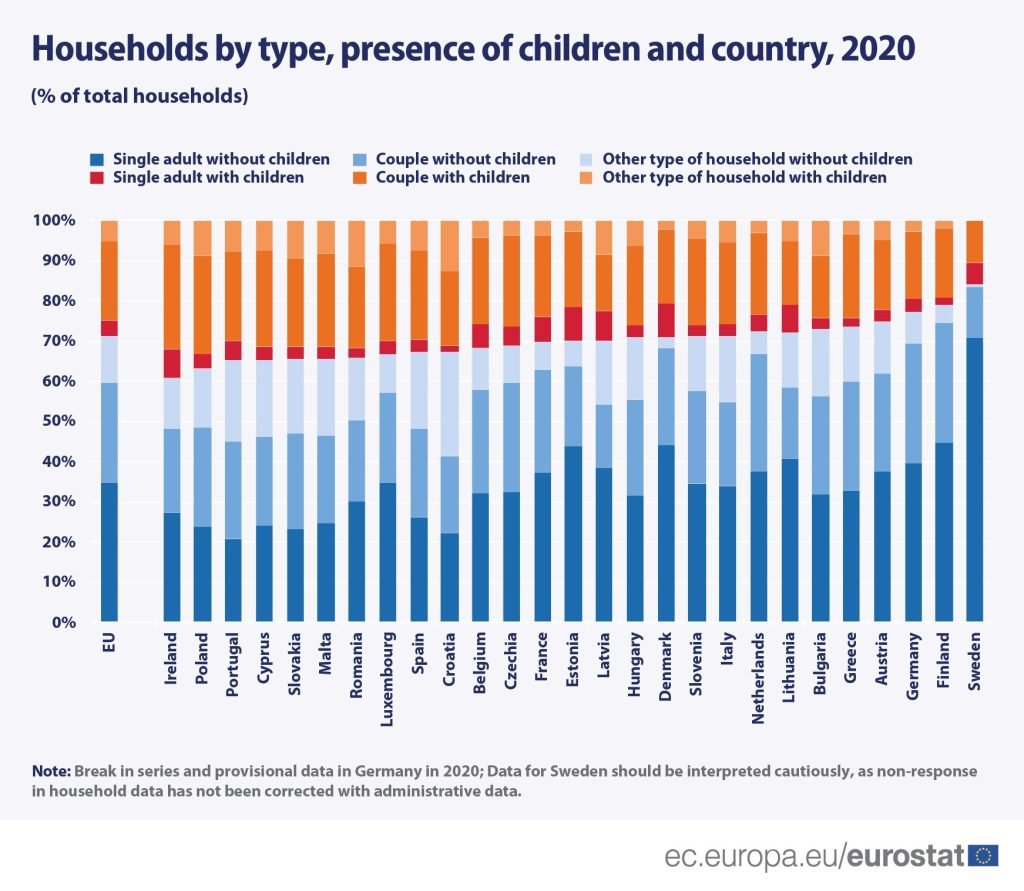
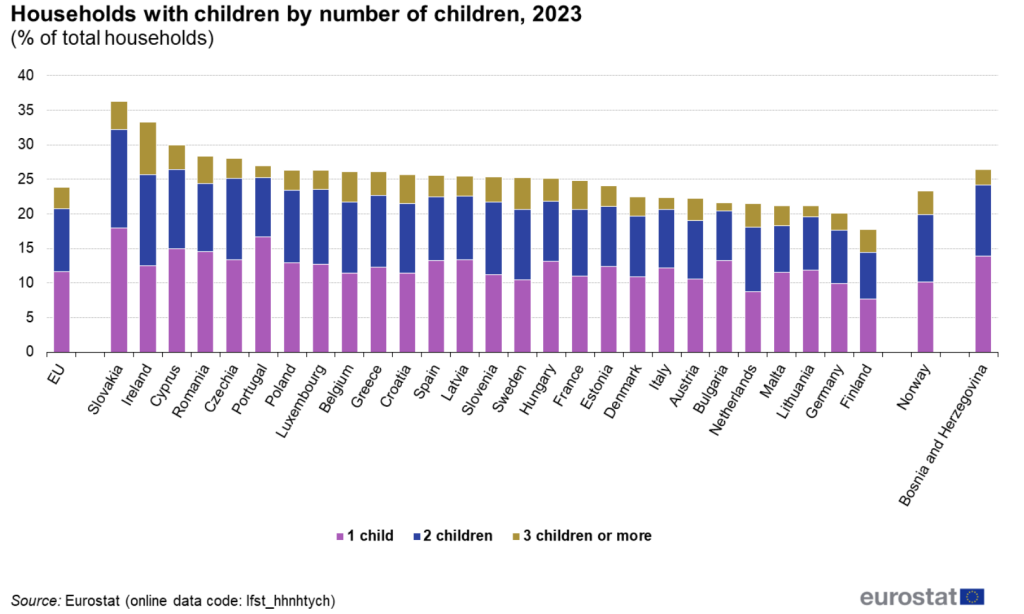
- 198.5 million households, 76% have no children, 24 % have children.
- 12% of households have 1 child; 9% have 2 children; only 3% have 3 or more children.
- Only 1/4 of European children have 2 or more siblings (Eurostat, 2022; child: person between 0-18 years).
- In 2021, poverty affected about 32% of large families, 17% of households with 2 children, and around 16% of families with 1 child (Eurostat).
These data show that the situation of large families in Europe is not good. We suffer social, labor, and economic penalties, social stigmatization and the risk of poverty and social exclusion is increasing. We live in countries where the family dimension of people is absent, and ignored, and this is the root of many new problems, of which we are beginning to see the first manifestations and which will continue to grow.
After years of trying out different solutions, such as economic transfers for children, measures to reconcile work and family life, etc., and to no avail (demographic winter occurs in both rich and poor countries, with or without support measures), we are concluding that the problem lies in the social and cultural model we have developed, where priority is only given to individual well-being and professional careers, and therefore, children are seen as a “problem”, and not as a social and personal value, no matter how much help we want to give them.
What can we do?
But how can this be put into practice? At the local level, the municipalities of the European Network of Family-Friendly Municipalities work to disseminate good practices that make the territories attractive for family life, also from businesses and the local economy. At the national level, this task is being carried out by our associations, promoting the introduction of the family perspective in all public policies.
At the European Union level, which is where our Confederation works, in our manifesto we specify some measures that can be carried out. They are the following:
- To recognize the central role that families play in society, economy, and sustainability.
- To include the protection of families in the European Social Pillars, according to the European Social Charter.
- To assume the family lens perspective in European legislation.
- To continue the task of a Commissioner for Demography, developing family-friendly policies in addressing demographic challenges.
- To support the right to have the desired number of children and the right for every child to receive the same support without any discrimination by the number.
- To clearly distinguish and separate family policies from social inclusion policies, and regard them as an investment in the wellbeing and the quality of human capital.
- To promote and sustain “family friendly municipalities“, naming the “European Capital City of Families”, the same way it is done with the smart, green, or cultural city.
- To promote and incentivize “Family Friendly Companies / Employers” and assure the work-life balance for parents and caregivers, equal opportunities and treatment, without any maternity or paternity gap.
- To recognize the role and value of unpaid care work in children’s upbringing and well-being, including it in the calculation of national GDP as a first step towards accounting for invisible work in pensions and wages.
- Finally, to work closely with representative organizations of families from all Member States, and improve research and studies about families and their well-being, at all ages.
Today, large families, those who decide to have more children than the average number needed for generational replacement, become true revolutionaries, the model to look to to break out of this self-destructive spiral. They compensate for the low birth rate and provide the human capital necessary for economic and social development. They promote a sustainable lifestyle and an economy of scale. Values such as generosity, mutual help, sobriety, and sharing are lived in their midst. In a world where there are no more siblings, cousins, or aunts and uncles, large families re-establish the family network as the best social policy against loneliness.
A large family has the “right to appropriate social, legal and economic protection to ensure its full development.” (Eu. Social Charter).
For this reason, we are also working to develop a European strategy for large families. Because large families make a significant and specific contribution to the European Union by enriching social and cultural diversity, economic growth, and social cohesion, while at the same time representing a key demographic factor. They also represent a relevant key driver of sustainability and a circular economy as a natural playground of solidarity, sharing and caring, creativity, teamwork, and mutual support.
Therefore we call on the European Union to develop a “strategy for large families”, based on the European Social Charter, encouraging Member States to increase financial support through tax deductions and family allowances proportional to the number of children, while providing affordable and high-quality childcare, education, healthcare, and transport to reduce the financial burden on parents.
The strategy could include employment policies, including measures to prevent discrimination based on family size.
Holistic and overarching, the strategy should also include support for family businesses (both small and medium companies, and agriculture), housing, and the needs derived from the Green Deal Directive, such as the provision of solar panels, electric vehicles for large numbers of passengers and measures to increase building efficiency.
The strategy should also include concrete programs such as the European Large Family Card, a non-financial support measure to ease mobility and access to sports, and cultural and educational programs, preventing economic and cultural poverty among large families.
Taking Action
Do we want to solve the demographic winter? Let us then promote a family-friendly social and cultural model, where having children is treated as a positive value recognized at all levels, and where large families are a model that can be realized and developed, with the support of society as a whole. Large family associations play a fundamental role in leading and bringing this battle to the public agenda, making it possible for having the desired number of children not only to be impossible but also to receive the social and economic recognition it deserves.
But, as I’ve written before, for the desire to have children to grow and become a reality, a real change, a real revolution is needed so that the family dimension of people is introduced as the center of everything, and so that children are no longer considered a problem, but are instead treated and recognized as a great value, both social and personal. It is a total cultural paradigm shift. And I believe that thanks to the work of associations of large families, and family-friendly municipalities, of which there are more and more, this change, this revolution, is already beginning. With the power to bring new lives into the world, and with the testimony and example of today’s heroes who bring them, the change will come, and eventually, it will spread throughout the world. There is no other way. I am convinced of this.
For this reason, this 21st century must be the century of the ‘family revolution’, where the family dimension of people is recovered and given space, above the productivity, consumerism, and hedonistic well-being that prevails today. Our future is at stake.
That is why we can safely say that the large family, in a phrase, is the springtime of our society. The one that can bring light, joy, and hope for the future, in this old Europe that is about to disappear.