
The organisation currently has 30 member associations from 25 European countries
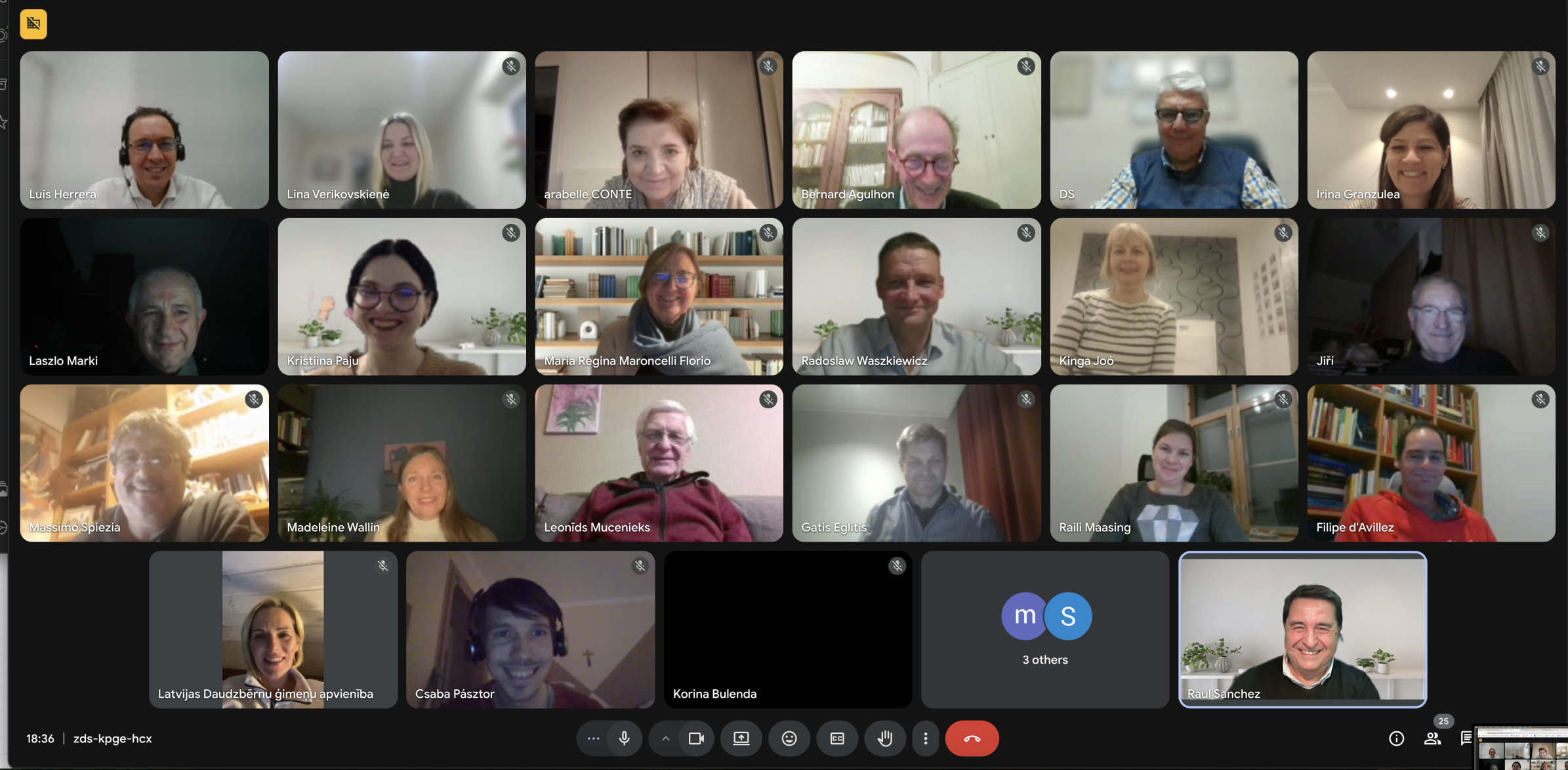
The assembly was scheduled to be held in person in Brussels on the same day, 25 November, but the general strike called by the main Belgium trade unions for that day included all land and air transport, affecting airports and connections to the capital. For this reason, the ELFAC board decided to suspend the Brussels meeting and hold it exceptionally online.
After our president, Radoslaw Waszkiewicz, welcomed the participants, Raul Sanchez, secretary general, presented a report on the activities carried out during the year. He highlighted the various actions carried out at the United Nations to emphasise the need to support large families and not penalise them, as well as the training activities of member associations and participation in various international events.
With regard to next year’s objectives, in addition to deciding where our 13th congress will be held, there was discussion about setting up a committee of experts to help us draft two papers: one on housing and large families, and another on taxation and large families. The launch of the European Large Family Card will be one of the main activities for next year, as well as continuing our work with the United Nations, European institutions, and the network of municipalities. Regarding this last point, Regina Maroncelli, coordinator of the European Network of Family-Friendly Municipalities, summarised its main activities. To date, 165 municipalities from eleven European countries are members. Work has been done on new guidelines for the Network, as well as on its extension to a new European network focused on family-friendly companies. In the first half of 2026, we will hold the 5th network congress, as well as the 6th convention on best practices.
The assembly ended with presentations by some associations on activities carried out or challenges to be addressed that could be of interest to everyone.
The two associations that recently joined ELFAC began: the LAPE association from Finland and Famille&Liberté from France. This was followed by presentations from the associations of Spain, Portugal, Romania, Lithuania, Italy, Hungary, Latvia and Greece.
All agreed that much work has been done, but also that much remains to be done to avoid penalising families based on the number of children they have and to give them the value and recognition they deserve.