

Large families remain insufficiently recognised, despite being exposed to poverty risks at disproportionate levels when considering the collective costs associated with housing, childcare, education and daily living. Currently, family size is not considered as a vulnerability factor in the implementation of social policies, which limits the capacity of the Child Guarantee to reach all children equally.
The European Child Guarantee (ECG) aims to promote the social inclusion of children in need by offering them:
- free and effective access to:
- childcare,
- education (including school-based activities and meals),
- healthcare;
- effective access to:
- healthy nutrition,
- adequate housing.
Given the persistence of child poverty, the European Commission is preparing a Communication to outline measures aimed at strengthening the Pact for Children, supporting its implementation at national and local level, and improving access to essential services for children in need.
This is ELFAC’s response to the public consultation launched by the European Commission on how to strengthen the European Child Guarantee:
Written by Tanishka Enugu
Strengthening the European Child Guarantee (EGC) is essential to address the persistent and complex nature of child poverty.
The number of children and households with children is decreasing in Europe, and in 2024 only 23,6% of households had children under 18 (Eurostat).
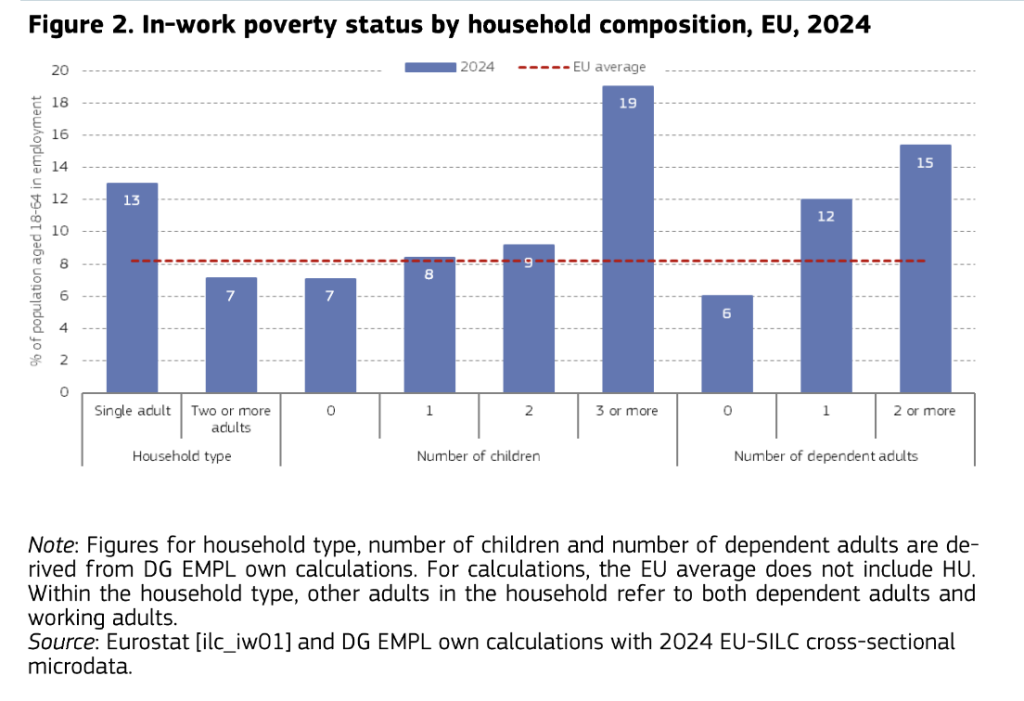
In Europe, having children is the second poverty risk after losing the job, and families with 3 and more children, together with single parents with children, record the highest poverty rates. In Italy, 20,7% of families with 3 and more children are in poverty.
Still, the “ECG recommends Member States to take into account specific disadvantages experienced, in particular, by: • homeless children or those experiencing severe housing deprivation, • children with disabilities, • children with mental health issues, • children with a migrant background or ethnic minority origin, in particular Roma, • children in alternative, especially institutional, care, • children in precarious family situations “. (see: First version of the joint monitoring framework for the European Child Guarantee, prepared by the Social Protection Committee’s Indicators’ Sub-Group and the European Commission, 21/12/2023, p.1).
At the moment there is no data concerning the incidence of poverty relating to the number of siblings in the households and large families are not considered eligible to support.
In order to “better reach children at risk of poverty or social exclusion” ELFAC believes that child poverty should be addressed and fought at the family level, in order to break the poverty circle. Still, we read that “To facilitate the monitoring of the implementation of the European Child Guarantee, the Indicators Sub-Group of SPC agreed on the usefulness of prioritising the child-specific indicators over the household-based ones”, as if children could be extrapolated from their environment, and their poverty could be treated independently.
ELFAC believes that the Child Guarantee should also work as a tool to prevent child poverty in large families, providing childcare, education (including school-based activities and meals), healthcare, and effective access to healthy nutrition to all children. Preventing children’s poverty should be seen by member States as a tool to fight denatality from gross roots, not a cost but an investment in human and social capital.
It is ELFAC’s position that in order for this initiative to be effective, it must reflect the diversity of family situations and address structural gaps in current policy design. Specifically, large families remain insufficiently recognised, despite being exposed to poverty risks at disproportionate levels when considering the collective costs associated with housing, childcare, education and daily living.
Currently, family size is not considered as a vulnerability factor in the implementation of social policies, which limits the capacity of the Child Guarantee to reach all children equally. As mentioned in our Housing and Large Families Position Paper, a stronger focus is needed to ensure that access to key services such as childcare, education, healthcare, nutrition and adequate housing is adapted to the realities of larger households and does not diminish from the second or third child onwards.
Improving access to adequate and affordable housing for large families in particular remains crucial, considering current housing shortages and rising costs across Europe. Better use of EU and local funding instruments, as well as data collection and monitoring which include family size as a key indicator, would significantly strengthen the impact of the initiative.
A more inclusive and family-size-sensitive approach would reinforce the Child Guarantee’s contribution to social cohesion and ensure that no child is disadvantaged in their ability to benefit because of the number of siblings they have.