

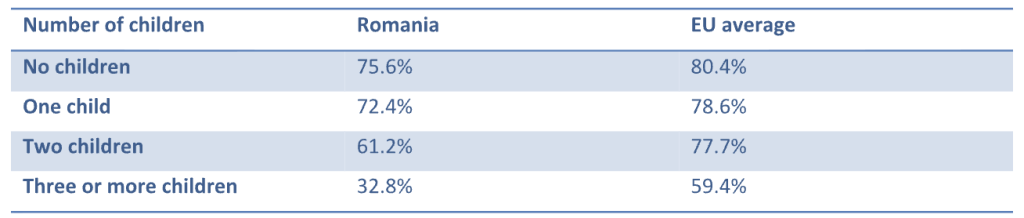
In most European Union countries, an increasing number of mothers are in employment. In Romania, however, the trend is reversed. According to Eurostat data for 2025, only 32.8% of Romanian mothers with three or more children are employed, compared with an EU average of 59.4%. Romania also ranks last in the EU in terms of employment among mothers with two children.

By Professor Mihaela Mosora, PhD, Vice-President of ASFANU – Romanian Large Families Association on profit.ro
These figures reveal a structural problem: the larger the family, the more difficult it becomes for women to pursue their professional careers.
The arrival of a child brings joy but also requires a reorganisation of everyday life, including working hours, leisure time and career plans. With the arrival of a second or third child, the pressure increases. In Romania, returning to work becomes a struggle for many mothers.
Consider a hypothetical scenario that is familiar to many parents. A mother has three children, two of whom are still young. In the morning, she gets them ready for kindergarten and school. One child falls ill, another needs to be picked up earlier, and her working hours cannot be adjusted. Grandparents are not always available, while hiring a nanny costs more than many families can afford.
At some point, the family weighs the financial implications. Childcare, transport and other work-related expenses can consume a significant proportion of the mother’s salary. In the short term, staying at home may appear to be the less expensive option. In the long term, however, this decision comes at a cost: lost professional experience, missed promotion opportunities, reduced earnings and, eventually, a lower pension.
More often than not, it is the mother who gives up her job. Not necessarily because she wants to, but because she has no alternatives.
How freely can a choice be made when affordable childcare options are unavailable?
The second child: The point at which Romania diverges from Europe
However, a significant divergence occurs with the arrival of a second child. The employment rate among mothers with two children falls to 61.2% in Romania, while the European average remains at 77.7%. In other words, the transition from one child to two is associated with an 11.2 percentage-point decline in Romania, compared with less than one percentage point (0.9) across the EU.
According to Eurostat data on women aged 25–54, the gap between Romania and the EU average is relatively moderate among women without children or with only one child. In 2025, 75.6% of women without children in Romania were employed, compared with 80.4% across the EU. Among women with one child, the corresponding figures were 72.4% and 78.6%.
Among mothers with three or more children, the gap widens further: 32.8% in Romania compared with 59.4% in the EU. In practical terms, approximately one in three Romanian mothers with at least three children is employed, compared with almost six in ten across the EU.
This raises an obvious question: why are other European countries able to accommodate both motherhood and professional careers, while Romania is not?
Across Europe, more mothers are working. In Romania, fewer are
Even more concerning than Romania’s position in the rankings is the direction in which the country is heading. In 2016, almost 47% of Romanian mothers with three or more children were employed. By 2025, this figure had fallen to 32.8%. Over the same period, the European average increased from 54.3% to 59.4%.
The situation among mothers with two children is even more striking. Romania is the only EU Member State where the employment rate declined between 2016 and 2025, from 64.8% to 61.2%. In the rest of the EU, the trend was upward.
Long-term comparisons should be interpreted with caution, as the methodology of the European Labour Force Survey changed in 2021 following the implementation of Regulation (EU) 2019/1700. However, Romania’s decline continued after 2021, meaning that it cannot be attributed solely to this methodological change.
Comparisons with other countries in the region are even more revealing. In Hungary, the employment rate among mothers with three or more children increased from 42.9% in 2016 to 63.3% in 2025. In Slovakia, it rose from 45.5% to 63.2%. In Poland, almost 64% of these mothers are employed, while Slovenia reaches 86.7%, one of the highest rates in the EU.
When motherhood comes at a professional cost

Economists refer to this phenomenon as the motherhood penalty or child penalty: the loss of earnings and professional opportunities associated with having children. In their study Children and Gender Inequality: Evidence from Denmark (2019), Henrik Kleven, Camille Landais and Jakob Egholt Søgaard demonstrate that, in Denmark, having children creates a long-term earnings gap of approximately 20% between women and men.
This figure relates specifically to Denmark and cannot be directly applied to Romania, but it illustrates the underlying mechanism: a temporary career interruption can have lasting consequences. Using Eurostat data, we can calculate an employment gap among mothers, defined as the difference between the employment rate of women without children and that of mothers.
In Romania, this gap amounts to 14.4 percentage points for mothers with two children and 42.8 percentage points for mothers with three or more children. Across the EU, the corresponding figures are considerably lower: 2.7 and 21 percentage points, respectively. An important clarification is that these figures do not measure the impact of childbirth on the career of the same woman. They compare different groups of women who may differ in terms of education, income, age or place of residence. Nevertheless, the magnitude of Romania’s employment gaps warrants serious analysis.
The cost is also reflected in pension entitlements, even where legislation appears to protect mothers. Parental leave is recognised as a period of employment seniority and counts towards the contribution period required to qualify for a pension. However, Romania’s new Pension Law (Law No. 360/2023) awards additional “stability points” to individuals with more than 25 years of contributions:
- 0.5 points per year between 25 and 30 years;
- 0.75 points per year between 30 and 35 years;
- One point per year beyond 35 years.
Periods of parental leave are excluded from this calculation.
Consider a mother of three children who takes two years of parental leave for each child and reaches retirement with a total qualifying period of 35 years. For the calculation of stability points, however, only 29 years are taken into account. She receives two stability points instead of the 6.25 points that a colleague with the same total employment seniority but without parental leave would receive.
At the current reference point value of RON 81, this represents a difference of approximately RON 340 per month throughout retirement. In other words, every child raised during parental leave reduces the additional pension benefit awarded for a long career.
Why is it so difficult to combine motherhood and employment in Romania?
There is no single cause. Most likely, the situation results from a combination of factors that become more challenging with each additional child. Returning to work after parental leave. In Romania, parental leave lasts up to two years, or three years in the case of a child with disabilities, under Government Emergency Ordinance No. 111/2010.
This represents an important form of support. However, when children are born relatively close together, absence from the labour market may extend to four years or more. Upon returning, job requirements, professional skills and available opportunities may have changed. The state provides a return-to-work incentive for parents who resume employment earlier: RON 1,500 per month if they return before their child reaches six months of age, and RON 650 after that age.
Financial incentives alone, however, cannot solve the problem. Without childcare arrangements and compatible working hours, returning to employment remains difficult. Access to nurseries and kindergartens. Even for a family with one child, securing a nursery place can be
challenging. With two or three young children, these difficulties multiply.
Nursery and kindergarten opening hours do not always align with parents’ working schedules, while private alternatives are expensive or difficult to access. In rural areas, the situation is often even more challenging. Lack of flexibility. The possibility of working part-time, adapting working hours or gradually returning to employment can determine whether a mother retains her job or leaves the labour market.
Claudia Goldin, recipient of the 2023 Nobel Prize in Economics, has demonstrated that many professions disproportionately reward availability for long and inflexible working hours (Goldin, 2021). Those who require flexibility pay a price in terms of earnings and career progression, with parents of young children among the first to be affected.
Household financial considerations. If the additional income earned by the mother barely covers childcare costs, her employment becomes difficult to justify financially. These are all plausible explanations that require further investigation. Eurostat data alone do not allow us to
quantify the contribution of each factor.
When the state makes part-time employment more expensive

There is, however, one obstacle directly attributable to government policy: the taxation of part-time employment contracts. For a mother with two or three young children, working four or six hours a day can make the difference between remaining professionally active and withdrawing from the labour market.
Romania’s Fiscal Code (Law No. 227/2015) stipulates that when a part-time employee earns less than the minimum wage, pension and health insurance contributions are calculated using a statutory minimum contribution base, as though the employee were earning almost the full minimum wage.
Employees pay contributions only on their actual earnings, while employers cover the difference.
Certain exemptions apply to specific categories of pupils and students, apprentices, people with disabilities, old-age pensioners and individuals with multiple employment contracts whose combined earnings reach the required threshold. However, parental status is not among the exemptions.
Consider a concrete example. From July 2026, the gross minimum wage is RON 4,325, while the minimum contribution base for part-time employment is RON 4,125. A mother working four hours a day at the minimum wage earns approximately RON 2,160 gross per month. Social security contributions corresponding to this income would amount to approximately RON 760, but the law requires contributions of around RON 1,445.
The difference, almost RON 690 per month, is paid by the employer, representing nearly one-third of the employee’s gross salary. As a result, part-time employment contracts become less attractive to employers precisely where they could be most beneficial. This creates a contradiction. On the one hand, the state aims to increase employment and women’s participation in the labour market. On the other, it maintains a tax rule that discourages one of the forms of employment most suitable for parents with young children.
The rule serves a legitimate purpose: preventing fraudulent part-time contracts used to reduce social security contributions. However, this objective must be balanced against its impact on genuine employment opportunities. We do not know to what extent this rule contributes to the low employment rate among mothers, but the mechanism deserves a separate assessment.
One possible solution could be a more favourable tax regime for part-time employment contracts for parents with several children, subject to clearly defined eligibility conditions and safeguards against abuse.
Romania is losing not only workers but also economic potential
Maternal employment is generally discussed as an issue of equal opportunities or family policy. However, it is also an economic issue. Romania faces an ageing population, increasing pressure on its pension system and the need to make better use of its available workforce. In this context, mothers with two or more children who are not employed represent untapped potential: women who have invested in their education, accumulated professional experience and could continue contributing to the economy.
For families, two incomes mean greater financial stability and better prospects for children. For the economy, higher female employment means increased output, greater tax revenues and a broader contributor base. Supporting mothers who wish to work should therefore be regarded not merely as social expenditure, but as an investment.
Encouraging higher birth rates is not enough. We must also support families who
already have children
The debate on demographic decline has focused primarily on falling birth rates and how families can be encouraged to have children. But what happens after children are born?
What support is available to a mother who wants to return to work after having her second child? What options are available to a family with three young children in which both parents work? How accessible are childcare facilities, and how well prepared is the labour market to accommodate these families? These questions should be at the heart of public policy.
A coherent family policy would support families not only at the time of childbirth but throughout the years when childcare responsibilities are particularly demanding. Possible policy directions include:
- Expanding the network of childcare facilities;
- Promoting flexible working arrangements;
- Supporting professional reintegration following parental leave;
- Reassessing the taxation of part-time employment contracts;
- Including parental leave periods in the calculation of pension stability points.
Families with three or more children require particular attention. Not because they should be privileged, but because their responsibilities and costs are different, and the data show that mothers in these families face the greatest difficulties in remaining in employment.
A society that wants children must enable parents to work
Beyond percentages and rankings, these figures tell a story about the choices Romanian families make and the constraints within which they are forced to make them. Having a second or third child should not automatically mean having to choose between family and career.
Some mothers choose to stay at home, and their decision must be respected. The problem arises when leaving employment is not a genuine choice but a consequence of the lack of alternatives. The current situation warrants a reconsideration of the support provided to families.
Parental leave allowances are important, but they do not address the challenges associated with returning to employment. Perhaps the right question is not why mothers with several children are not working, but why Romania is failing to create the conditions that would enable them to work.
Answering this question should become a priority for Romania’s economic, social and family policies.