
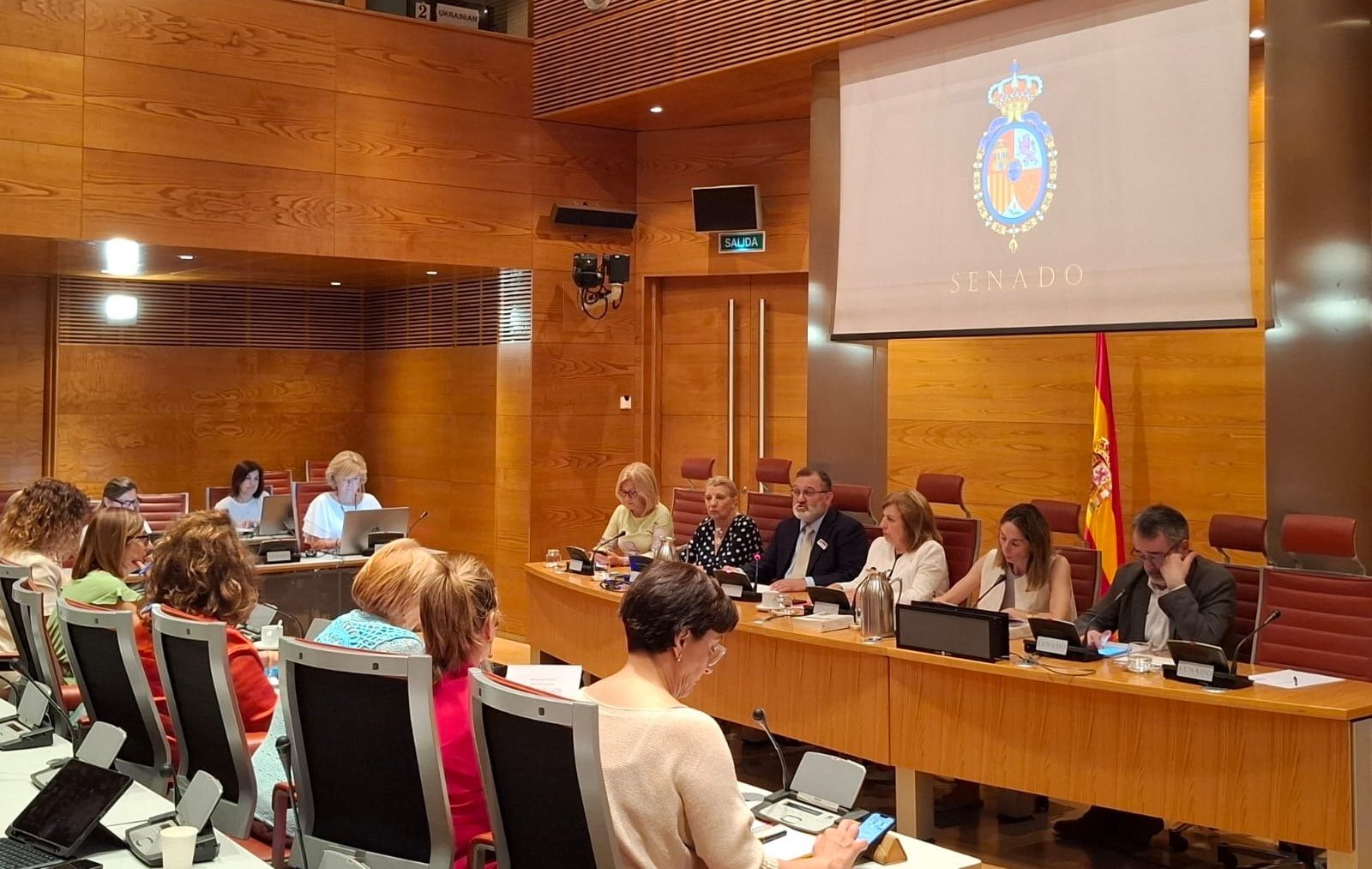
The Spanish Federation of Large Families (FEFN) has participated in the Senate representing large families, to expose the reality of these households and demand greater support in public policies.
The Vice President of the FEFN, Eduardo Galicia, appeared at the request of the People’s Party (PP) Group before the Family Rights Committee of this House, where he proposed a series of support measures to compensate for the social contribution of families with children, especially large families, and alleviate the economic pressure they face.
In this regard, he alluded to the cost of raising children, estimated at €8,000 per child per year, according to Save the Children, and the high level of vulnerability of large families —those most at risk of poverty, along with single-parent families— in a country that invests well below the European average in children and family, with 1.2% of its GDP compared to 2.3% for Europe as a whole.
The FEFN (Federal National Fund for Family Welfare) has called for an increase in this investment in the form of direct aid that has a real impact on families’ lives, such as the universal child benefit, similar to that applied by other EU countries, to support families with the costs of education and raising each child.
In this regard, he highlighted the current penalization of large families in many aid programs or benefits, which only consider children up to the second or third child, and the need to end this “unfair situation that penalizes those who contribute the most.”
The Vice President emphasized that “all children count, all have needs, and it is necessary to eliminate the unfair limits applied by the number of children in access to public aid, which discriminate against large families.”
Work-life balance, one of the main problems facing families, was also the focus of attention in the appearance of the Vice President of the FEFN, who called for strengthened support measures so that families can dedicate more time to their families. Among other things, FEFN asked for an extension of maternity leave from 16 to 20 weeks, with two additional weeks for large families, and for paid leave for caring for children under 8 years of age, as required by the European directive, so that it serves as a real measure of work-life balance, as many families cannot access it.