
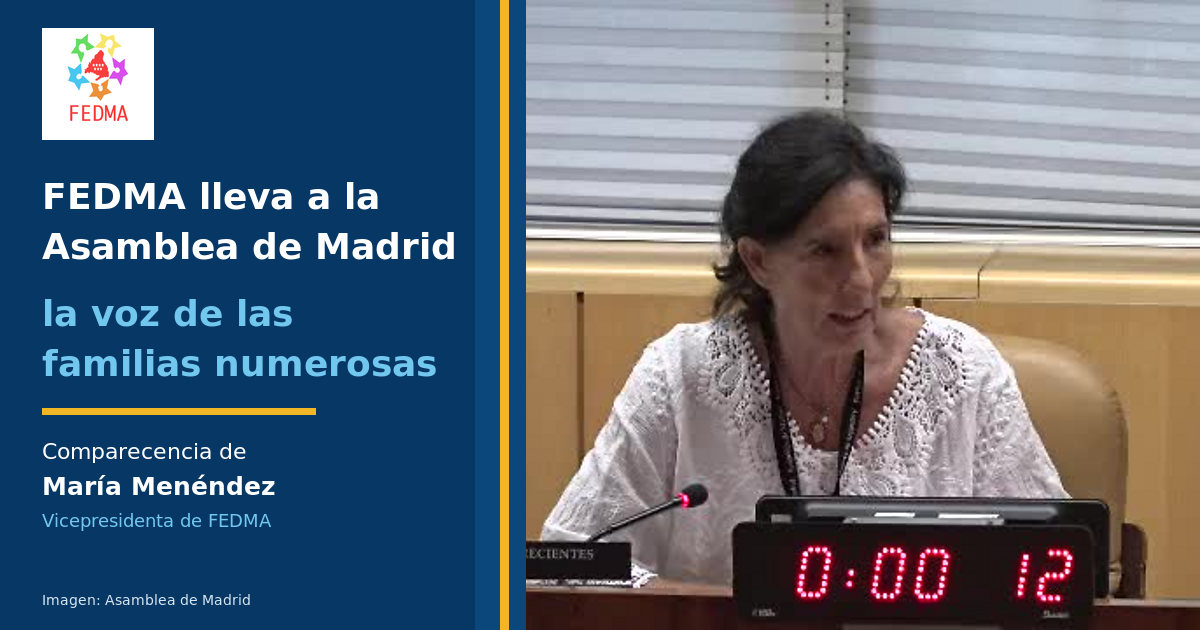
María Menéndez de Zubillaga, Vice President of FEDMA, appeared before the Family and Social Affairs Committee of the Madrid Assembly (Parliament) to convey the daily reality of large families and demand that support measures be adapted to their real needs.
During her speech, María Menéndez highlighted the essential contribution made by large families at a time marked by low birth rates and an aging population. “We are not here to ask for privileges, but to ask for recognition of an objective reality.”
Families with three or more children face higher expenses for housing, education, food, transportation, and childcare. However, many are excluded from assistance programs because their income barely exceeds the established limits, even though their actual financial capacity is very different from that of households with fewer members.
Adequate housing is not a luxury.
One of the main issues addressed was access to housing with sufficient space. FEDMA called for public and affordable rental housing developments to include an adequate number of spacious homes, as well as real priority for large families. He also proposed making it easier for families to access larger subsidized housing when their current home becomes too small after the birth of new children, in addition to offering assistance to adapt or redistribute their usual residence.
More support for education and school meals
María Menéndez pointed out that school meal grants, early childhood education aid, and book programs should take into account the real cost of educating and caring for three, four, or more children.
Among the proposals submitted, the following stand out:
- Free school meals for large families in special category.
- Enhanced coverage for large families in the general category.
- Review of income limits to prevent numerous families from being excluded.
- Publication of data that allows us to know how many large families apply for these benefits, how many receive them and how many are left out.
FEDMA argued that family policy should not be limited solely to situations of poverty, but should also compensate for the economic and social effort involved in raising several children.
Effective regrouping of the brothers
The Vice President of FEDMA also denounced the difficulties that some families continue to encounter in enrolling all their children in the same school. Although there is an exceptional procedure to facilitate regrouping, in practice refusals may occur when the incorporation of a minor exceeds the maximum ratio of the classroom. FEDMA requested a single protocol for all territorial area directorates, with transparent criteria, defined deadlines, and individualized resolutions. It also proposed allowing, with appropriate educational safeguards, a limited exception to the student-teacher ratio when it is the only obstacle to reuniting siblings. Reuniting them reduces travel, facilitates work-life balance, and provides stability for children.
Taxation adapted to the number of children
In tax matters, FEDMA demanded that regional tax deductions should apply to all families while they hold the qualification, and not just during the first few years after obtaining it.
The proposals put forward include:
- Strengthen the deductions starting with the third child.
- Review the income limits that exclude many middle-class families.
- To ensure that support for descendants has a more direct and visible effect.
- Recognize the benefits from the date of application for the title so that administrative delays do not harm families.
Menéndez pointed out that a household’s economic capacity cannot be assessed solely by its income, without taking into account the number of people who depend on them.
Mobility and transport
FEDMA pointed out that the family vehicle is essential in many households to balance school, work, medical appointments and activities. Therefore, he reiterated his demand for free public transport passes for large families in the special category, announced in 2023, as well as parking and mobility solutions adapted to family vehicles. He also asked for corrections to be made in cases where a family loses benefits such as the reduction of the registration tax because the degree takes months to be issued.
Less bureaucracy and a one-stop shop

Another of the highlighted problems was the delay in issuing or renewing the large family certificate and the lack of coordination between administrations. During the waiting period, families may temporarily lose access to social assistance, transport discounts, tuition fees, and other benefits. They must then file individual claims with each relevant agency, and retroactive application of these benefits is not always granted.
FEDMA proposed that the registered application should have provisional effects until its resolution and that a single window should be created to inform and process, whenever possible, the benefits linked to the title. María Menéndez also warned of errors that occurred after the transfer of the title data to Digital Account, which have caused problems with some tax breaks and have forced the affected families to file appeals.
Evaluate whether the aid actually reaches the families
FEDMA demanded that all measures aimed at large families incorporate public indicators, periodic monitoring and evaluation of results. It is not enough to approve or announce aid: it is necessary to know how many families apply for it, how many are excluded, what the reasons are, and whether it is applied in the same way throughout the Community of Madrid. The Federation offered the collaboration of its associations, which maintain direct contact with thousands of households and can quickly detect problems and inequalities in the application of the measures.
Family policy as an investment in the future
In conclusion, María Menéndez called for a clear distinction between social welfare policy and family policy. Both are necessary, but they serve different purposes. While the former addresses situations of need, family policy must recognize the contribution that families with children make to society as a whole and also reach households that work and exceed certain income thresholds, but bear the extraordinary cost of raising several children.
At FEDMA we will continue to collaborate with the administrations and convey the voice of large families to achieve policies that truly reach homes and improve their daily lives.