

Alarm bells are going off in Japan as the decline in births shows no sign of stopping. A survey by the Ministry of Health, Labor and Welfare found that about 339,000 babies were born in the first half of 2025, down more than 10,000 from the same period last year – and a record low for the year if the current decline continues.
The ministry said preliminary figures from January through June show 339,280 births, including foreign nationals. That’s down 10,794, or more than 3.1 percent, compared to the same period last year – and about 30 percent from a decade ago.
If the decline continues at this pace in the second half of the year, the number of births in 2025 will hit a record low for a full year. The ministry said the number of young people is decreasing and they are marrying later in life, a trend that is difficult to tackle.
“We are in a critical situation where we cannot stop the rapid decline in the number of births,” it added. The ministry said it would continue to work on measures against the declining birthrate along with other ministries and agencies.
How did this happen?
Katsumata Chieko specializes in reporting on healthcare, education and Japan’s population decline for NHK World. She said the current dire situation results from many factors.
“Raising children is expensive, balancing work and family is hard, and many young people are uncertain about the future,” she said. In addition, while dual-income households are now common, traditional gender roles remain strong.
“That means many women still shoulder most childcare and housework in addition to their jobs, making marriage less appealing for some,” Katsumata said.
Japan is not alone
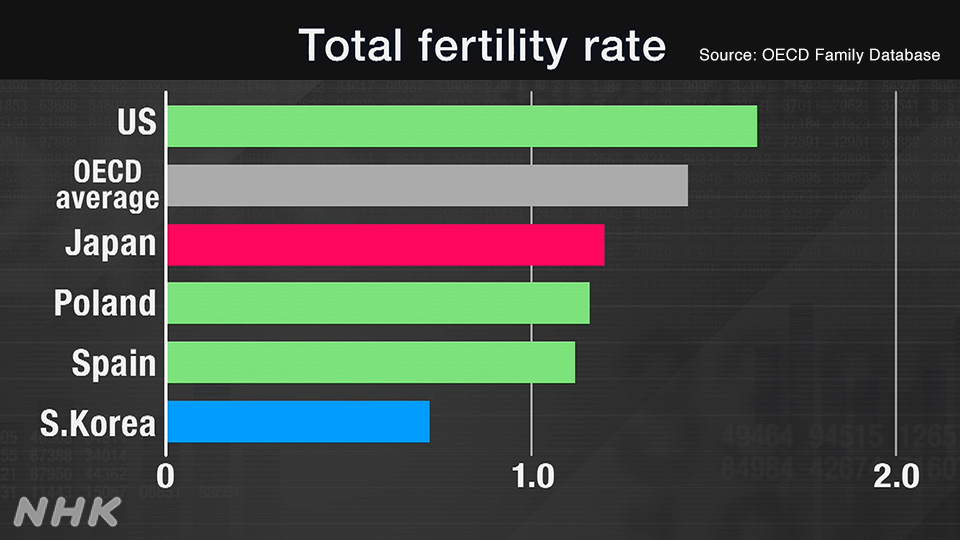
Falling births are a global issue. OECD data indicate that fertility rates across member countries are now less than half their level six decades ago. Japan’s total fertility rate in 2023 was 1.20 – among the lowest in the OECD.
But at 0.72, South Korea’s was even lower, making it the only OECD member below 1. In 1970, its total fertility rate was over 4.
At a recent summit, the two governments agreed to collaborate on the issue. Kim Myoung-jung, an expert, says that behind the situation in both nations lie many points in common.
“Japan and South Korea share a lot of similarities in the employment environment, family values and the impact of Confucian thought,” he said.
“In particular, the division of gender roles is still strong, so that the burden of childcare remains largely on women. Then there’s the Confucian emphasis on women having children after marriage,” he added.
Steps to address the issue
Katsumata said South Korea is allocating significant funds to address the issue. On top of that, local governments are also taking action.
“Incheon, a city neighboring Seoul, provides affordable housing to newly married couples without permanent homes, charging only 30,000 won – less than 20 dollars – per month in rent,” she added.
Another example is major construction conglomerate Booyoung Group, which provides a cash subsidy of 100 million won – approximately 72,000 dollars – to employees upon the birth of a child.
In Japan, the government has ramped up its response to the issue since April by taking new steps, said Katsumata. These include removing income caps on child benefits and increasing parental leave payments.
Environment is key
Experts have noted that many of the policies in both nations focus on support after marriage, rather than policies that help couples tie the knot.
“There’s a lack of support for young people who can’t get married because they can’t secure stable employment and places to live,” said Kim, at the NLI Research Institute.
“If the government sets up an environment where young people can get married and have kids, that will have a positive impact,” he added.
Katsumata acknowledged that marriage and having children are personal choices, and building an environment that promotes matrimony remains a challenge.
“Even so, surveys show that over 80 percent of young men and women in Japan want to get married,” she said.