
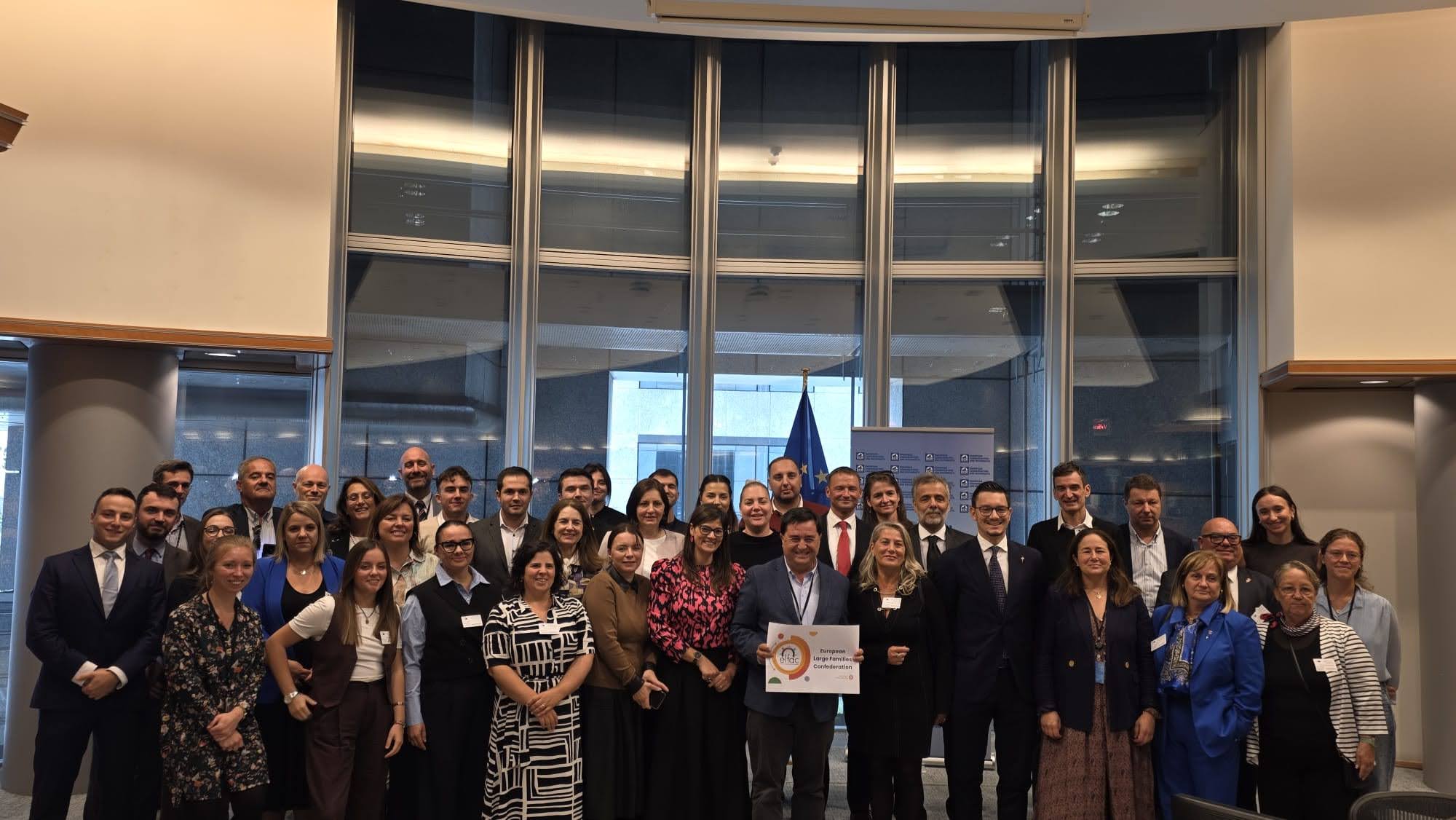
The conclusions of the Better Future Festival were also presented by the four municipalities that participated in this project, led by ELFAC and funded by the European Commission’s CERV programme.
The event took place at the European Parliament in Brussels, Belgium, on Thursday 25 September 2025, and it was organized by ELFAC and the Intergroup on Demography of the Parliament, with his co-chair MEP Paolo Insalvini, who opened the presentation with an introduction on the demographic situation and family culture in Europe. Before his speech, he read a letter of support on behalf of Antonella Sberna, vice president of the European Parliament.
Radek Waszkiewicz, president of ELFAC, spoke about the general difficulties faced by large families in Europe, and in Poland in particular, where legislation does not take into account the number of children and, for this reason, large families are often penalised in terms of taxes, basic consumption, etc: “The remedy for both diseases – demographic collapse and the pandemic of loneliness – is the family. All of us, politicians, scientists, psychologists, sociologists, non-governmental organizations should open our minds and seek answers to the question of how to help the next generations restore trust and the ability to create lasting lifelong relationships and discover the joy and happiness of ordinary family life with a spouse and a bunch of children. It sounds so simple, but the reality shows it is not so simple.”
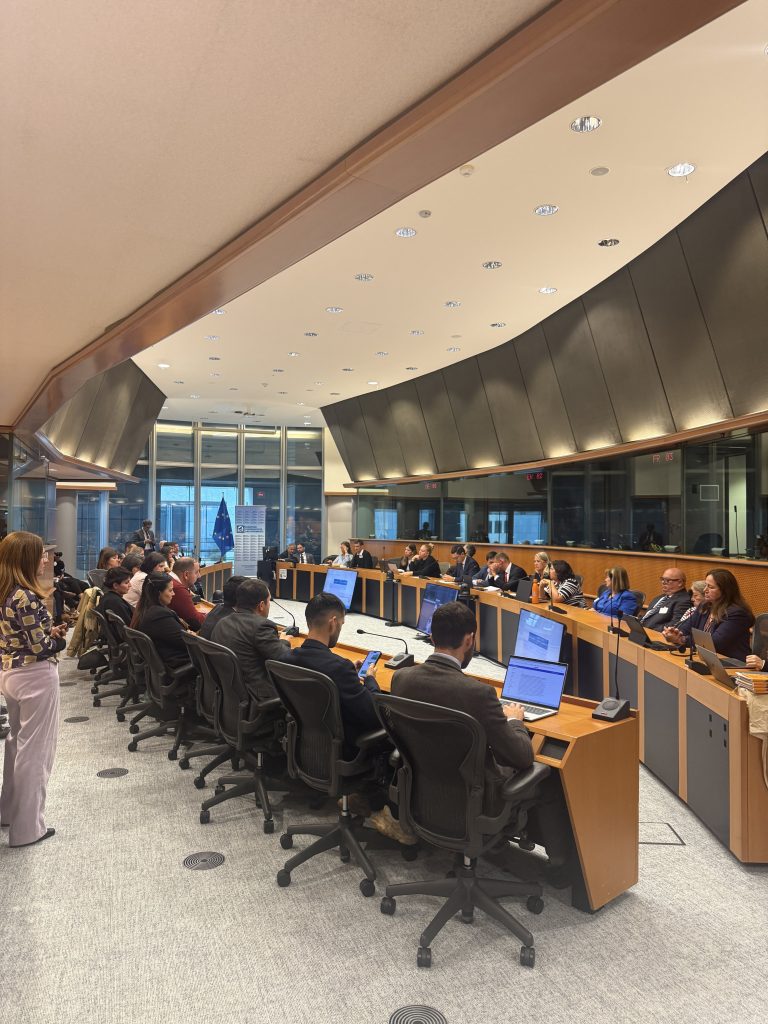
Raúl Sánchez, secretary general of ELFAC, presented the context of a Europe with a serious decline in birth rates for many years, which affects the continuity of its welfare system, and ELFAC’s demands on European institutions to reverse this situation by giving greater support to families who wish to have more children, with clear social recognition of their value: “For the desire to have children to grow and become a reality, a real change is needed, a genuine revolution, so that the family dimension of people is truly considered in our social model, and so that children are no longer considered a problem, but are treated and recognised as a great value, both collectively and personally. It is a total change of cultural paradigm.”
After this opening, representatives of large families associations from different countries exposed real examples of these penalties suffered by reason of the number of children. Filipa Baker, responsible of the Portuguese Observatory of Family-Friendly Municipalities, exposed some cases collected through its website “one child counts one”: “The State must take into account the reality of families. And taxes are no exception. The current system has obvious flaws. The number of children is undervalued in income tax deductions, property tax rules and rental support. These are some examples of an injustice that runs through the entire tax system and must end”.
Irina Granzuela, president of Romanian Large Families Association ASFANU and Board’s member of ELFAC, talked about the situation in her country with some examples of unequal treatment for large families, that can be summarized in this situation in public transport: “According to the travel regulations, children under the age of 5 are entitled to travel free of charge only if they do not occupy a separate seat. However, if a separate seat is requested, children up to the age of 10 are granted only a 50% discount. This regulation places large families at a disadvantage: while it may be manageable for one or two small children to travel on their parents’ laps, it becomes unsafe and impractical when several children are under the age of 5 and each needs a seat.”
Diana, a mother of seven from Dublin, Ireland, presented her case: she lives in a room in a homeless hotel because no one wants to rent a house in Dublin to a family with seven children. Her case has been brought by ELFAC before the United Nations Commission on Discrimination against Women.
There were similar interventions by representatives of the associations of Germany, Italy or Spain, and others representatives of civil society as Kata Eplényi, from the KINCS Institute from Budapest (The Maria Kopp Institute for Demography and Families), who introduced its report: “The European Union Family Policy Outlook 2024“. Also Teresa Gerns, from FAFCE, the European Federation of Catholic Family Associations, or from the European Disability Forum.
Margarita de la Pisa, mother of nine and Member of the European Parliament, exposed her personal experience and her conviction that we need to advance seriously to a more family-friendly Europe, supporting families and creating attractive enviroments for having children.
The second part of the event consisted of the presentation of the conclusions of the Better Future Festival project, with the participation of the cities of Alghero (Italy), Creixell (Spain), Bacau (Romania) and Gdynia (Poland). Participating municipalities shared their experiences with the Better Future Festival project, as well as any new developments in their communities.
Lucian Andrei, from the municipality of Bacau (Romania), presented their experience with the Better Future Festivals initiative. Arguably, Bacau had one of the most enriching experiences with this project, forming a deep-rooted connection with the Italian municipality of Alghero. The two cities have initiated collaboration on projects outside the scope of the Better Future Festival, with representatives from Bacau scheduled to travel to Alghero just next month to sign a cooperative agreement. The cities are also working towards establishing a sister cities initiative for cross-border support and cultural exchange. Bacau also shared their “blueprint for family-friendly living”, a comprehensive group of policies developed in to promote family-friendliness in Bacau.
Maria Grazia Salaris and Enrico Bachisio, from the municipality of Alghero (Sardinia, Italy), presented its experience with the program, thanking ELFAC and the other member municipalities for their consistent engagement and open discussion. Furthermore, Alghero spoke about its up-and-coming partnership with Fondazione Bruno Kessler, a multidisciplinary research institute in Trento, Italy. The municipality hopes to further connect with this organization to develop novel solutions to municipal issues, forging a path towards a family-friendly future.
Katarzyna Korzeniewska, from the municipality of Gdynia (Poland), and Montserrat Muñoz, from Creixell (Spain), shared similar sentiments towards the program, expressing that they felt better supported and equipped to handle the challenges of their individual municipalities. Through open discussion and sharing of ideas, each individual municipality has a new ‘tool kit’ to continue revitalizing it’s community, working towards a greener future, and encouraging the growth of family networks.
The event finished with the lecture of the Manifesto of young people, summarizing the discussions that took place in the four previous events. It was read by Debra and Jacopo Vuchich, two young brothers from Alghero (Italy).