

A recent Eurostat article reports the dramatic demographic decline of our continent.
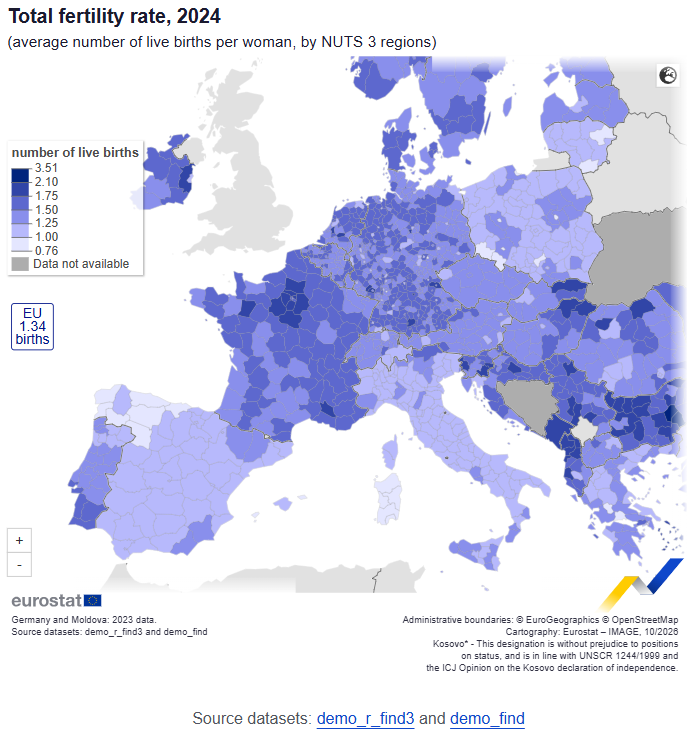
In recent decades, the EU’s total fertility has been declining rapidly. In 2024, it fell to a low of 1.34 live births per woman, registering the lowest level since 2001.
The natural replacement rate is 2.10, a target that has been out of reach for over 20 years, with fertility rates ranging from 1.34 to 1.57 live births per woman.
Of the 1165 EU regions surveyed, 37.7% (439 regions) recorded total fertility rates below the EU average, 61.3% (714 regions) recorded rates above the EU average, and the remaining 12 regions recorded data that match the European Union average.
Higher fertility rates of at least 1.75 live births per woman were concentrated in specific European areas, notably across 14 regions in both Bulgaria and France, 6 in Germany, 3 in Slovenia, and 2 each in Hungary, the Netherlands, and Romania. Single regions in Ireland, Greece, Croatia, and Slovakia also reached this level.
Conversely, birth rates were exceptionally low in parts of Southern and Central Europe. Fertility dropped below 1.00 births per woman in 16 regions in Spain (especially in the northwest and island areas), 7 in Poland, 5 in Italy (particularly Sardinia), 3 in Greece, and 2 each in Germany and Lithuania.