
From the Constitution to the neighborhood: Alghero’s Office of Family Policy puts shared governance into practice
Luciano Malfer – Research and Family Development Manager, Fondazione Bruno Kessler (FBK)
The quality of public policies depends on the ability of institutions to recognize the expertise within society and to involve it in the pursuit of the general interest. This is the meaning of horizontal subsidiarity, enshrined in Article 118, paragraph 4, of the Constitution, which commits institutions to fostering the autonomous initiative of citizens—both individually and collectively—in activities of general interest.
This principle is implemented in Articles 55 and 56 of the Third Sector Code (Legislative Decree 117/2017): the former governs joint planning and design with public entities; the latter governs agreements with volunteer organizations and social promotion associations, under the conditions set forth by law. Constitutional Court Ruling No. 131/2020 recognizes Article 55 as a significant implementation of subsidiarity, outlining a model of shared governance. At the international level, the OECD Recommendation on Open Government emphasizes the participation of citizens and other stakeholders in policy-making and service design.
In family policies, this approach takes on concrete significance. Families are familiar with the challenges of balancing work and family life, the barriers to accessing services, the costs of raising children, and the resources available through neighborhood networks. This experience can accelerate understanding of the issues, bring to light hidden needs, and foster relationships built on trust. Involving families and community organizations means integrating administrative and professional expertise with practical knowledge, which is valuable for shaping municipal policies.
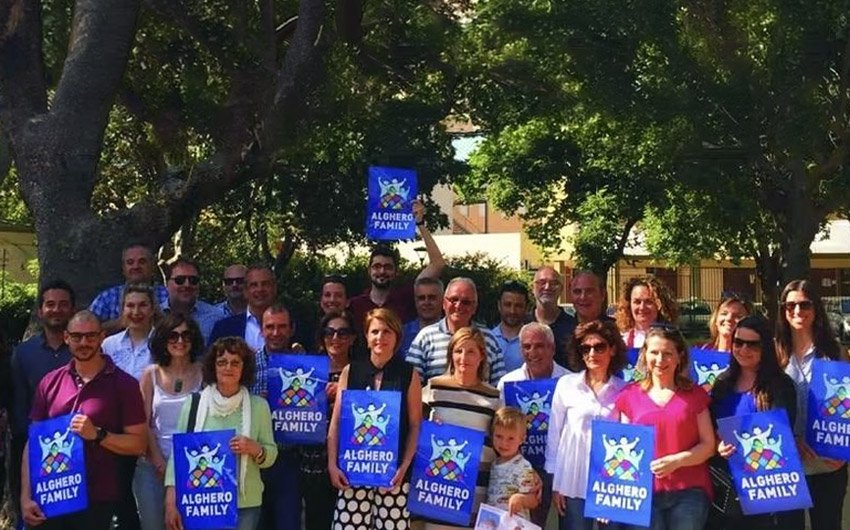
In Alghero, this collaboration takes the form of the Office of Family Policy, established in July 2016 and entrusted, through an agreement, to the National Association of Large Families. The Office implements the Family Policy Plan, monitors initiatives and their local impact, prepares an annual report, and compiles an inventory of the services and opportunities for families offered by various organizations in the city.
The initiative has both a national and a European dimension: Alghero serves as the lead municipality of the National Network of Family-Friendly Municipalities and is a member of the corresponding European network, promoted by ELFAC, the European Large Families Confederation. An agreement between ELFAC and the municipality has strengthened this role, entrusting Alghero with the task of supporting and guiding Italian municipalities interested in joining the European network.
Launched before the Third Sector Code came into effect, this initiative puts the principle of subsidiarity into practice: the associations’ expertise supports the continuity of public action through planning, implementation, and evaluation. Following the discussion with the administrators, Mauro Ledda and Filomena Cappiello, the Office’s directors, take the floor to elaborate on the work that links institutional decisions to the daily lives of families.
The Office of Family Policy was established through a collaboration between the City and the National Association of Large Families. What does it mean, in your work, to put the principle of subsidiarity into practice?
It means recognizing that families can help shape the policies that affect them. The experience of being part of an association helps us examine together issues that are often addressed separately: school schedules, parents’ work, commuting, children’s activities, and caring for the elderly. Our contribution consists of bringing this everyday perspective into our discussions with the administration, transforming it into understandable and practical proposals. The perspective of large families highlights certain obstacles, but the Office’s focus is on the well-being of all families.
The agreement provides a framework for this relationship. The Office operates at the municipal level and collaborates with administrative departments, associations, and economic operators. For us, subsidiarity requires this reciprocity: a willingness on the part of the institution to listen and an ability on the part of associations to make commitments. Administrative responsibilities remain with the competent bodies; the contribution of associations brings awareness of needs, relationships, and the capacity for initiative. Collaboration gains value when it leads to continuity, clear objectives, and opportunities to assess the work carried out. (algherofamiglia.it)
How do we move from listening to families to developing tools that truly help in everyday life?
A first step is to make clear what the local area already offers. The Dossier on Existing Family-Support Policies is based on a survey of the services and opportunities provided by the municipality, associations, and other local organizations. Compiling this information helps people understand who to turn to, what opportunities are available to them, and what eligibility requirements apply. A service may be available yet remain out of reach for those who need it; this is why information and guidance are an essential part of the work on family policies. (Alghero Famiglia)
One example is the “Digital Family Help Desk” (website and social media channels @Alghero Family), a platform designed to: provide information and help match families’ needs with opportunities tailored to them; listen to the local community by gathering direct feedback and identifying needs; enhance the local network of services for families; and promote facilities certified as “Family Friendly” by the municipal administration.
How do you engage local organizations, businesses, and service providers to ensure that supporting families becomes a shared responsibility?
We need to provide concrete opportunities for participation. The Alguer Family Festival is one such opportunity: the program, as documented by the City, brings together activities in neighborhoods and villages, intergenerational initiatives, sports, culture, and opportunities for educational exchange. The Office is responsible for organizing and coordinating the event in collaboration with the Alghero Foundation, Porto Conte Park, and numerous local organizations. The value of such an event also lies in the relationships it helps build: people with different skills learn to work toward a common goal, and families can gain a closer understanding of their city’s resources. (City of Alghero)
When working with businesses, a focus on families must translate into recognizable features of the offerings. The guidelines for the “Alghero Family” brand—including those for lodging facilities—provide a concrete framework for this commitment. The key question is how a family actually experiences a place: what services they find, how accessible those services are, and to what extent the organization takes their needs into account. This perspective links hospitality with the quality of the local area. For us, a network works when each member identifies their own contribution and makes it verifiable, turning a focus on families into a practice that is integrated into day-to-day operations. (comune.alghero.ss.it)
How does the Alghero experience relate to the role of the European ELFAC network, and what outcomes will be important to monitor?
Local initiatives become models for other regions when they are shared within broader networks of subsidiarity. In 2021, the Region of Sardinia tasked the City of Alghero, through its Office of Family Policies, with guiding Sardinian municipalities toward “Family-Friendly Municipality” certification, helping local governments develop sustainable plans. This collaborative effort is underpinned by the European Large Families Confederation (ELFAC), which promotes the European Network of Family-Friendly Municipalities—a European network comprising several countries and over 200 municipalities dedicated to spreading best practices in social welfare. In this context, Alghero plays a key leadership role as a member of the network’s technical board and as coordinator of the Italian network of family-friendly municipalities.
The synergy between ELFAC’s European network, the Italian coordination in Alghero, and local associations combines the region’s appeal with a people-centered approach. To assess whether these initiatives truly improve daily life, it will be essential to examine actual access to services, the compatibility of service hours with family schedules, the active participation of families, and the continuity of public partnerships. It is precisely by maintaining this link between the European level and the local community that institutional action continues to provide concrete responses to the needs of families.