
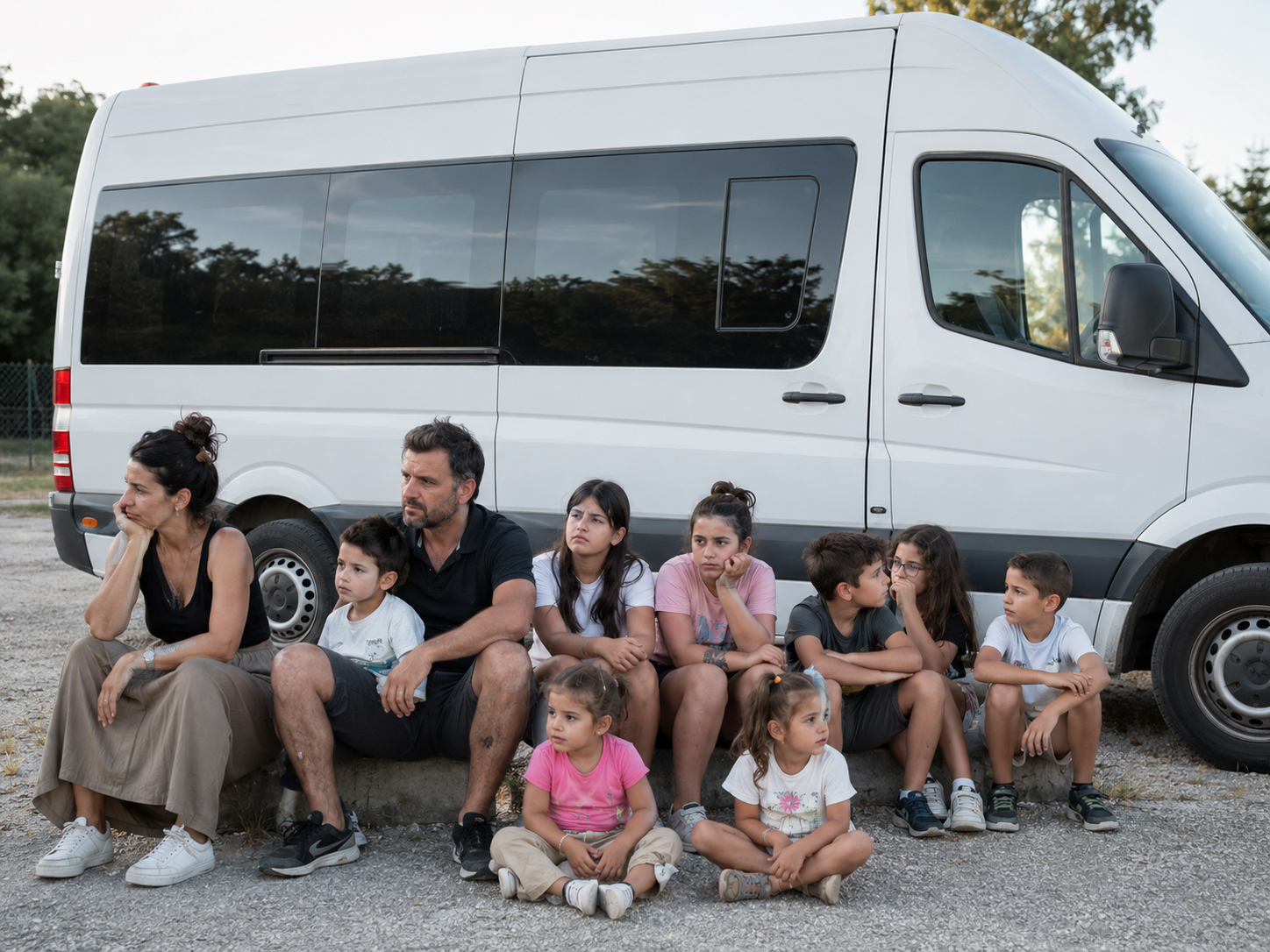
There are problems that are only visible when a family actually experiences them. One of these concerns the mobility of particularly large families, especially those with more than seven children
For a family of two parents and eight children, a standard nine-seater vehicle is no longer sufficient. A larger vehicle is needed, a minivan or minibus with at least ten seats. But this is precisely where the problem arises: once the total number of seats exceeds nine, including the driver, the rules change. It is no longer a standard family car, but a vehicle subject to different regulations, with implications for registration, circulation, and even the license required to drive it.
The Ministry of Infrastructure and Transport indicates that the B licence allows you to drive motor vehicles designed to transport no more than eight people in addition to the driver, while for vehicles designed to transport a greater number of people different categories come into play, such as the D1 or D licence. ( Ministry of Transport ).
For many families, this isn’t a technicality, but a real obstacle. It means not being able to travel together, not being able to calmly plan a vacation, a visit to relatives, a trip for family, sports, education, or community reasons. In some cases, it means having to travel by two vehicles, resulting in higher costs, organizational difficulties, and reduced safety. In other cases, it simply means giving up.
As the National Association of Large Families, we have received concrete reports from families in this situation: families with eight children, unable to use a nine-seater vehicle because it is insufficient for the entire family, and forced to seek larger solutions, only to encounter bureaucratic and interpretative obstacles. In one of the reports received, the family noted that they had been waiting for a long time to register a 15-seater van for private use, precisely so they could travel together safely.
For this reason, ANFN formally notified the Ministry of Infrastructure and Transport, also notifying the Ministry of Family Affairs, Birth Rates, and Equal Opportunities. In the request, we highlighted how the problem affects particularly large families, including those with ten or more members, who have a clear and demonstrable need for a suitable vehicle for the entire family unit’s transportation needs.
Specifically, we have requested a reexamination of the interpretation of the concept of “community” for the purposes of minibus registration. The legislation and implementing circulars refer to the possibility of recognizing a group of people united by a stable bond and a common interest as a community. It is therefore difficult to understand why a large family, which by its very nature represents a stable, permanent bond oriented toward common goals, should be excluded from this possibility.
ANFN’s request is simple and common sense: allow even large families, when the conditions apply, to register and use a minibus for private family use, without having to navigate uncertain routes that vary from region to region or are left solely to the goodwill of individual offices.
We’re not asking for a privilege. We’re asking for families to be able to move together, legally and safely. We’re asking that the legislation also take into account those families who, precisely because they’ve welcomed so many children, find themselves with specific needs that cannot be ignored.
In a country that claims to support the birth rate and recognize the social value of the family, these concrete aspects also matter. Mobility is not a secondary issue: it concerns school, work, sports, social life, holidays, family relationships. In short, it concerns the ability to fully live one’s family life.
We therefore hope that the Ministry of Infrastructure and Transport, also with the involvement of the Ministry of Family Affairs, can finally clarify and resolve this issue by identifying a simple, uniform, and accessible procedure for large families requiring a vehicle suited to their size.
Because no family should be penalized just for welcoming more children.